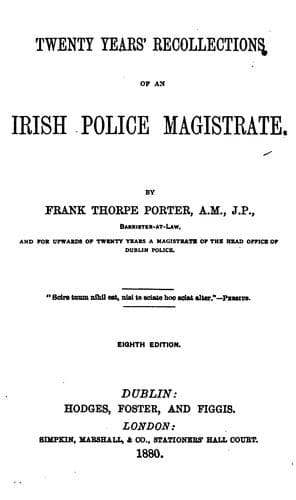
Twenty Years' Recollections of an Irish Police MagistratePorter, Frank Thorpe
History
Twenty Years' Recollections of an Irish Police Magistrate
Porter, Frank Thorpe
Crime -- Ireland; Criminals -- Ireland; Ireland -- Social life and customs; Porter, Frank Thorpe, 1801-1882
Colonel Vesey parted with Martin Keogh, _alias_ Vaughan, in the kindest
manner, and was soon after enabled to proceed to England. His military
career was terminated by a wound at the capture of Quebec, in 1761,
which incapacitated him for further service: he died at Bath in 1776.
The Count de St. Woostan accompanied the gallant but much calumniated
Lally-Tollendahl to India. He possessed his confidence, shared in his
dangers and subsequent persecutions, but eventually, freed from every
imputation, restored to the rank and emoluments of colonel, he died at
Amboise, in 1782. His name was Alen, and he belonged to a family which,
located at St. Woolstans, near Celbridge, in the county of Kildare,
occupied high position in Ireland previous to the reign of Elizabeth,
and from a collateral branch of which the ducal Howards of Norfolk
derive the additional name of Fitzalen.
Martin Vaughan married, in 1758, a _blanchisseuse de fin_, who had a
comfortable dwelling and profitable business in the _Rue de Bellechase_,
Paris. His name disappears from the register of the Invalides, in 1769.
His escape from Old Kilmainham protracted his existence twenty-six
years. It was effected by means which would not be practicable in any
prison of the British Empire at the present time. Officials have become
more respectable, and their integrity is protected from temptation by
the intervention of a vigilant superintending authority, unknown at the
period to which the foregoing narrative refers. It will, in all
probability, occur to the reader that the two persons whose co-operation
the gaoler considered as indispensable in effecting the escape of Martin
Keogh, were the coroner of the county and the medical officer of the
prison. Such a conclusion is almost inevitable. Still, a similar project
could not now be accomplished by a similar combination. There have been,
however, some inquests held in the same county (Dublin) which seriously
compromised the coroner of the time and the medical man habitually
employed by him, but none of them originated in a prison. It is right to
state that they occurred anterior to the appointment of the present
coroners and of their respective immediate predecessors. I shall recur
to them in a subsequent page or two, when I come to the narration of
some extraordinary incidents entirely within my personal knowledge and
recollection. As yet I have placed no female character prominently
before my readers. I shall proceed to introduce one; and however I may
distrust my own powers of description, I feel that the mere facts which
I shall detail will not prove uninteresting, especially as they refer to
her whom I may term the heroine of the story.
FOOTNOTE:
[1] This gratuitous cruelty did not cease when Old Kilmainham was taken
down. Similar disgusting figures have been seen by me, on the door and
walls of the condemned yard, in the present county gaol.--F. T. P.
CHAPTER III.
MARY TUDOR.
Public-domain text, read in full here on John Shaqi.
Reviews
Reviews
No reviews yet
Be the first to share your thoughts on this work.
Join the Discussion
Join the discussion
Sign in to leave a comment or review.
Sign InorCreate an account