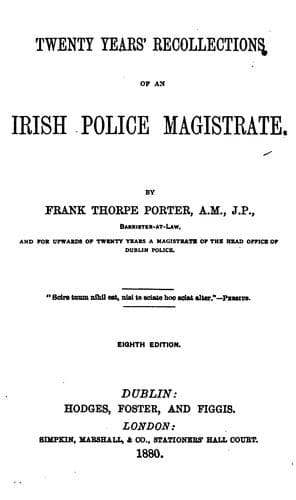
Twenty Years' Recollections of an Irish Police MagistratePorter, Frank Thorpe
History
Twenty Years' Recollections of an Irish Police Magistrate
Porter, Frank Thorpe
Crime -- Ireland; Criminals -- Ireland; Ireland -- Social life and customs; Porter, Frank Thorpe, 1801-1882
I found the steamer extremely convenient and most agreeable, especially
for a person debilitated by severe and recent indisposition. I do not
recollect the charges for conveyance or refreshments, but I considered
them moderate, and relished my repasts greatly, whether as regarded
their materials, culinary preparation, or table attendance. The few
hotels at which I stopped were very comfortable in every respect. At the
Giant Hotel, Coblentz, I observed that the delicious wine, sparkling
Moselle, was given for a Rhenish florin and a half, (two shillings and
sixpence,) per bottle, and that Guinness's Dublin Porter was precisely
the same price there. I have heard some Germans, who understood English,
remark on the designation almost universally given to the Rhenish wines
by us. The vineyards are nearly all on places considerably elevated, and
the names of the wines have generally the prefix of "High." The German
word is "Hoch," and they give it a guttural pronunciation which the
Irish and Scotch can utter perfectly, but which an Englishman cannot
accomplish. He hardens "hoch" into "hock," and adopts the prefix alone
as the name of the exhilarating fluid, and we follow his example. The
mistake, however, is perfectly harmless, for the abbreviation has not
lessened the production, or deteriorated the flavor of the liquor.
At Coblentz, I saw in a square before a church, the name of which I do
not remember, a monument with two inscriptions, the first of which I
considered indicative of silly and premature pride, whilst the second
formed an instance of a complete junction of wit and wisdom. In 1812,
when the French had occupied Moscow, the prefect of Coblentz erected the
monument and inscribed it thus--
AN. MDCCCXII.
MEMORABLE PAR LA CAMPAGNE
CONTRE LES RUSSES,
SOUS LA PREFECTURE DE JULES DOAZAN.[10]
In 1814 the fortunes of war had necessitated the retreat of the French
before the allied forces, and Coblentz was occupied by the Russians.
Instead of demolishing the memorable record of the previous campaign,
the Russian commander of the force, by which the town was captured,
caused a supplementary statement to be added, which clearly showed the
complete change of affairs. The addition was as follows:--
VU ET APPROUVE PAR NOUS, COMMANDANT RUSSE DE LA VILLE
DE COBLENTZ. 1 JAN. 1814.[11]
Public-domain text, read in full here on John Shaqi.
Reviews
Reviews
No reviews yet
Be the first to share your thoughts on this work.
Elsewhere in the archive
Join the Discussion
Join the discussion
Sign in to leave a comment or review.
Sign InorCreate an account