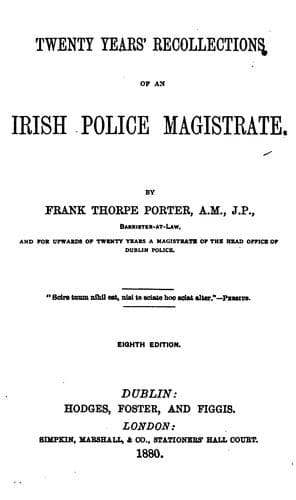
Twenty Years' Recollections of an Irish Police MagistratePorter, Frank Thorpe
History
Twenty Years' Recollections of an Irish Police Magistrate
Porter, Frank Thorpe
Crime -- Ireland; Criminals -- Ireland; Ireland -- Social life and customs; Porter, Frank Thorpe, 1801-1882
The people of Coblentz appeared to enjoy drawing a stranger's notice to
these inscriptions, and it was easy to perceive that they considered the
annexation of the Rhenish provinces to France, by the first Napoleon, as
not merely objectionable, but detestable and insufferable. I believe
that the same sentiments pervaded every part of Germany, which had been
under the rule or in the occupation of the French. As far as my sojourn
in Germany enabled me to form an opinion, I thought that the people
liked the English very much, and thoroughly disliked the French. I found
them most friendly, and on several occasions when I have wished to
procure fruit, and produced money, pointing at the same time to apple,
pear, or plum trees, in the _unfenced_ gardens and orchards near
Wiesbaden, the tree would be shaken, and signs made to me to pick up the
fallen fruits, and money would be declined. This kindness was accorded
to me because I was deemed an Englishman. I do not believe that an apple
would have been gratuitously tendered to a Frenchman. In the places of
public amusement, I repeatedly heard a certain lively tune played. It
seemed to be decidedly popular, and I was informed that it owed its
popularity to the fact of having been the quick-step to which the
Prussians advanced upon the flank of the French army at the close of the
battle of Waterloo.
In the preceding paragraph, I have mentioned unfenced gardens and
orchards. I have passed along roads in the Rhenish land where, for five
or six miles, there were no fences whatever between the highway and
grounds appropriated to the culture of choice fruits and vegetables, and
where no hedge, wall, or ditch intervened to distinguish or separate one
holding from another. The bounds were marked by poles, on the tops of
which bits of straw or dried rushes were placed; but even such marks
were not considered necessary at the edges of the public thoroughfare.
Of course, in those districts grazing was impracticable. No sheep or
goats were to be seen, no horses, unless such as were yoked or saddled;
and the food for the cows was usually conveyed, in the morning and
evening, from the place of its production, in a cart drawn by one of
themselves. The summer feeding for the cattle consisted of clover,
Italian rye-grass, Lucern, American cow-grass, or vetches. I observed
that the fodder was cut and left lying sufficiently long to become
flagged before it was given to the animals. The tillage in those
districts presented a great contrast to the generality of Irish crops.
Neatness and cleanliness characterized the German culture, and the weeds
were excluded from the partnership which is so liberally accorded to
them here. Near Wiesbaden, I saw a very flourishing crop, which
occupied, in my opinion, about two acres, and I was informed by Dr.
Greiss, that the elevation of the place above sea-level was 2400 ft. The
growth was tobacco, for the production of which our soil and climate are
Public-domain text, read in full here on John Shaqi.
Reviews
Reviews
No reviews yet
Be the first to share your thoughts on this work.
Elsewhere in the archive
Join the Discussion
Join the discussion
Sign in to leave a comment or review.
Sign InorCreate an account