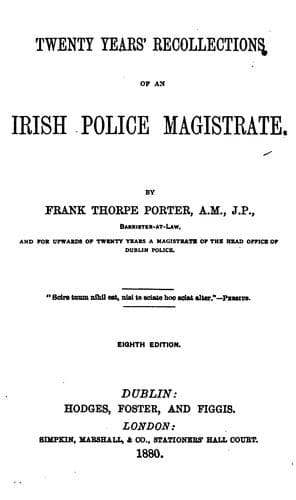
Twenty Years' Recollections of an Irish Police MagistratePorter, Frank Thorpe
History
Twenty Years' Recollections of an Irish Police Magistrate
Porter, Frank Thorpe
Crime -- Ireland; Criminals -- Ireland; Ireland -- Social life and customs; Porter, Frank Thorpe, 1801-1882
as well suited as those in which the Germans cultivate it. There it is
taxed, or, as I believe, taken by the Government at a valuation, and
made an Imperial monopoly. Here it is prohibited, to form, perhaps, a
very apt and forcible illustration of the principle of Free Trade.
The springs at Wiesbaden are not numerous, but they constitute great
natural curiosities. There is one which, if I remember rightly, is
called the Kochbrunnen. It is intensely hot; and I was told that even in
winter, the water is used for scalding the hair off slaughtered pigs.
It gushes up profusely; and yet, within fifty yards of it, there is a
spring extremely cold and effervescent, precisely similar to the Seltzer
water. Whilst the Roman empire continued, almost all the Rhineland was
appurtenant to it, and Wiesbaden was then designated "Mattiacæ aquæ." It
is believed that Nero visited it for the benefit of his health; and
there is a locality close to the town, where he is said to have
sojourned, and which is named Nerothal, (Nero's valley.) Some ancient
edifices have Latin inscriptions denoting their former use or the names
of their pristine occupants. The Germans take special care of such
antique remains; and instead of destroying relics of heathenism, they
show them as indicating a state of darkness and degradation to which
Christianity offers the greatest and most glorious contrast. In
reference to the gratitude of their votaries to Pagan deities for
benefits attributed to the exercise of their peculiar powers, I only
recollect one mythological inscription, which I was prevented from
forgetting by a ludicrous comment on it, made by a Manchester visitant
at Wiesbaden. In the Ræmerbad, (Roman bath,) there was a mural tablet in
perfect preservation, every letter on the stone being as distinct as
when cut many centuries ago. It was as follows:--
"ÆSCULAPIO SANATORI, MILITES QUATUORDECIMÆ LEGIONIS, OB
VALETUDINEM RESTAURTAM, HANC TABULAM VOTIVAM.
D.D.D."
The Manchester gent and I had become acquainted at the _table d'hôte_ of
the "Four Seasons," and we happened to stroll into the Ræmerbad at the
same time. Pointing to the mural tablet, he said--
"Mr. Porter, they say that is Latin."
"Yes," I replied, "you have been rightly informed."
"Could you untwist it, and tell us what it is about?"
"I shall try. To Æsculapius the healer, the soldiers of the fourteenth
legion, in consequence of their health being restored, give, inscribe,
and dedicate this votive tablet."
"Good heavens!" he exclaimed, "those chaps were wide awake; and they
knew how to pay a nice compliment, for of course this Skewlaypius _was
their regimental doctor_."
I regretted that there was not another tablet extant declaratory of
their veneration and devotion to Mars, for it would have elicited the
interesting suggestion that his military rank was, at least, that of a
colonel.
Public-domain text, read in full here on John Shaqi.
Reviews
Reviews
No reviews yet
Be the first to share your thoughts on this work.
Elsewhere in the archive
Join the Discussion
Join the discussion
Sign in to leave a comment or review.
Sign InorCreate an account