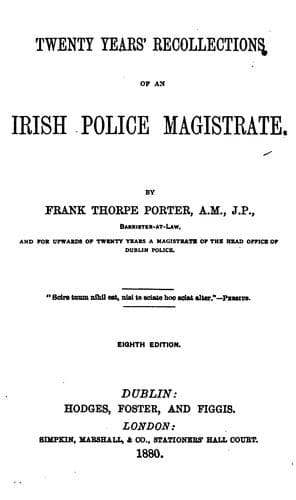
Twenty Years' Recollections of an Irish Police MagistratePorter, Frank Thorpe
History
Twenty Years' Recollections of an Irish Police Magistrate
Porter, Frank Thorpe
Crime -- Ireland; Criminals -- Ireland; Ireland -- Social life and customs; Porter, Frank Thorpe, 1801-1882
Skinner Row had its attachments, jealousies, and little diplomacies as
fully as ever they existed even in more important localities. In one
respect, it possessed a material for civic intrigue greater than could
be found in any other part of Dublin in the last century. The Row
commanded, in the Common Council, one seat for the Stationers' Guild,
and two for the Goldsmiths. As to those objects of ambition, there was a
certain fixed understanding--there should be no division outside their
own precincts, and the members chosen should be men of the Row. Amongst
themselves, intrigues, insinuations, or open opposition might be freely
practised; but once they had determined on the man to be supported,
every vote should go to him. Dick Tudor and James Wilson were the
goldsmiths chosen for the Common Council, and the distinction thus
conferred excited great envy in the mind of Tom Delancy, whose
discontent was kept fully alive by his son, not on account of civic
honours, but because young Christian Wilson had contrived to stand
between him and the sun in the rays of which he wished to bask, namely,
the eyes of pretty Mary Tudor.
Old Tudor and James Wilson were friends, not very intimate, but perhaps
liking and respecting each other more on that account. Tudor's daughter
and Christian Wilson were lovers, and the infrequency of their meetings
only rendered their occasional interviews more delectable. The
neighbours observed the attachment of the young people before their
parents suspected its existence; but the moment Tudor perceived a
preference evinced by his daughter for young Wilson, he sedulously
endeavoured to prevent all future communications between them. He became
suddenly anxious that Mary should visit some relatives in the County of
Wexford, about whom he had for years expressed no interest. He thought
change of air would materially serve her health, although no other eye
could notice the slightest indication of illness, or even delicacy of
constitution. Accompanied by an elderly female attendant, she left
Dublin by a conveyance termed Good's Long Coach, which the proprietor,
William Good, advertised as the perfection of cheap and expeditious
travelling. It left the Ram Inn, Aungier Street, Dublin, on each Monday
morning, at an early hour, so as to ensure reaching Wicklow town on the
succeeding night. Tuesday saw the vehicle achieve a further progress to
Gorey, and on Wednesday evening it reached Wexford. It returned to
Dublin in the three succeeding days, and thus enabled the public to have
a cheap, safe, and comfortable communication, to and fro, between two
places about ninety English miles asunder, within the short space of six
days.
Public-domain text, read in full here on John Shaqi.
Reviews
Reviews
No reviews yet
Be the first to share your thoughts on this work.
Join the Discussion
Join the discussion
Sign in to leave a comment or review.
Sign InorCreate an account