Twenty Years' Recollections of an Irish Police Magistrate — John Shaqi
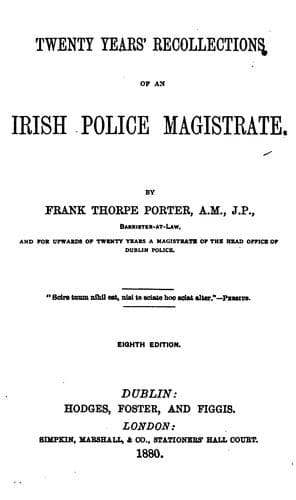
Twenty Years' Recollections of an Irish Police MagistratePorter, Frank Thorpe
History
Twenty Years' Recollections of an Irish Police Magistrate
Porter, Frank Thorpe
Crime -- Ireland; Criminals -- Ireland; Ireland -- Social life and customs; Porter, Frank Thorpe, 1801-1882
Towards the close of the last century, a gaol for the city of Dublin was
built, and its appearance had a great tendency to deter any person from
incurring the liability of becoming an inmate. Its soot-begrimed walls
and rusty portal completely falsified its designation of Newgate, and
its front constituted a considerable portion of a locality, the aspect
of which suggested no idea of verdure, although it was called Green
Street. It was a place replete with fatal memories, very few of which
are worthy of being evoked, and it has been completely taken down. The
sons of the gentleman who was governor more than fifty years ago were my
schoolmates, and my associations with them made me acquainted with some
incidents which may be worthy of narration. When Oliver Bond was under
sentence of death for treason; and whilst there was the strongest
probability that the law would take its course, he was permitted, during
the day-time, to occupy an upper apartment, the door of which was partly
of glass. Mrs. Bond was as much with him as the rules of the prison
allowed, and was sitting in the room on the day when Mr. Michael William
Byrne was executed as a united Irishman. The fatal procession had to
pass close by the door of Bond's apartment; and as it approached, Mr.
Byrne remarked to the sheriff, that Mrs. Bond would be greatly shocked
by seeing a person pass to that scaffold on which her husband expected
to suffer. Mr. Byrne then suggested that they should stoop and creep
noiselessly by the door, so as to escape her observation. His wish was
complied with, and on reaching the drop, he turned to the sheriff, and
remarked, with an air of great satisfaction, "we managed that extremely
well." This spontaneous solicitude to spare the feelings of an afflicted
female, will aptly class with that of the gallant Count Dillon, who was
one of the earliest victims of the Reign of Terror in France, and who,
when he arrived at the guillotine, was requested by a female
fellow-sufferer, to precede her, upon which the _preux chevalier_
saluted her with courtly grace, and stepped forward, saying, "anything
to oblige a lady."
In one of the back yards of Newgate, to the right of the entrance, was
the place of confinement for the condemned, the walls of which exhibited
initials, sometimes entire names of unhappy occupants. One, who suffered
the extreme penalty of the law nearly sixty years ago, for forging
notes of the Bank of Ireland, pencilled the following lines on the door
of his cell:--
"Unhappy wretch, whom Justice calls
To bide your doom within these walls,
Know that to thee this gloomy cell
May prove, perhaps, the porch of Hell.
Thy crimes contest, thy sins forgiven,
Mysterious change! it leads to heaven."
It is to be hoped that the soul of the poor prisoner experienced the
"mysterious change" which his untimely fate led him so fully to
appreciate.
CHAPTER VII.
GONNE'S WATCH.
Public-domain text, read in full here on John Shaqi.
Reviews
Reviews
No reviews yet
Be the first to share your thoughts on this work.
Join the Discussion
Join the discussion
Sign in to leave a comment or review.
Sign InorCreate an account