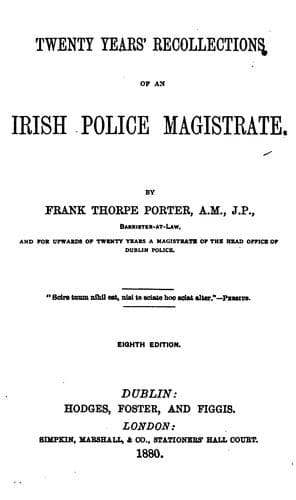
Twenty Years' Recollections of an Irish Police MagistratePorter, Frank Thorpe
History
Twenty Years' Recollections of an Irish Police Magistrate
Porter, Frank Thorpe
Crime -- Ireland; Criminals -- Ireland; Ireland -- Social life and customs; Porter, Frank Thorpe, 1801-1882
There may still be seen on the right hand side of the road leading from
Dublin through Mount Brown to Inchicore, a small portion of a granite
wall which formerly was in front of "Old Kilmainham," the common gaol of
the County of Dublin. That building was considered one of the worst
prisons of the kingdom, in consequence of its insufficient size and lax
discipline. Swift is said to have been, in his youthful days, a
frequent, although not a criminal visitor at this old gaol; and there,
perhaps, in the conversation of its inmates, he acquired much of the
coarseness and indelicacy which mar the wit and vigor of his
productions. I shall, however, most willingly and scrupulously abstain
from offering to my readers any specimens of the language of such a time
and place, when the building echoed with drunken revelry, and the
sufferings of a prisoner were aggravated by indecent buffoonery or
ribald jests. To my narrative such expressions are neither necessary nor
ornamental.
CHAPTER II.
VESEY AND KEOGH.
On the 15th of February, 1743, a gentleman named James Vesey, who held a
commission in the army, was returning to Dublin from a southern county
where he possessed a respectable landed property. The facilities which
now exist for the safe and prompt remittance of money were then almost
unknown, and he had with him upwards of eighteen hundred pounds in
specie. He was so unfortunate as to be stopped on the road at
Castleknock, and robbed of the money, his watch, and its appendages.
The highwayman who opened the door of the post-chaise had an associate
who kept at the horses' heads, and could not be recognized. After the
perpetration of the crime, the traveller proceeded on to Dublin and
apprised the authorities of his loss. A vigilant search terminated,
after a few days, in the apprehension of two brothers named Martin and
Sylvester Keogh. They were men of a sinister reputation, who resided
near Rathcoole, and spent more money than they could be supposed to have
acquired honestly, being the occupiers of a thatched house of humble
dimensions, and a neglected farm of six or seven acres. On being brought
before a magistrate, Martin Keogh was fully identified by Mr. Vesey, as
the man who, pistol in hand, opened the door of the chaise and despoiled
him of his property. Against the other there was no criminating
evidence, and after a detention of some days, he was discharged. The
closest search after the money terminated unsuccessfully, not a guinea
could be found. Martin Keogh was committed for trial at the ensuing
commission of _Oyer and Terminer_ for the county of Dublin, and was
there convicted of the robbery, on the positive and undoubtedly true
testimony of Mr. Vesey. Sentence of death was passed, and the doomed
felon became an occupant of the condemned cell at Old Kilmainham, from
the dreary precincts of which he was to issue at the end of twenty-one
days, to die upon the gallows. Mr. Vesey's leave of absence had been
Public-domain text, read in full here on John Shaqi.
Reviews
Reviews
No reviews yet
Be the first to share your thoughts on this work.
Join the Discussion
Join the discussion
Sign in to leave a comment or review.
Sign InorCreate an account