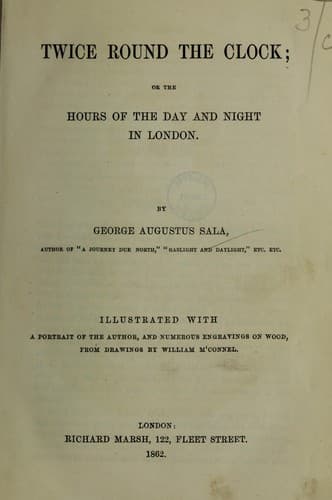
Twice round the clock; or, The hours of the day and night in LondonSala, George Augustus
General
Twice round the clock; or, The hours of the day and night in London
Sala, George Augustus
London (England) -- Social life and customs -- 19th century
Some dock-labourers lunch on too much beer and too little bread; for
they are held in thraldom by certain unrighteous publicans, who still
pursue, with great contentment and delectation to themselves, but to the
defrauding, ruin, and misery of their customers, the atrocious trade,
now well nigh rooted from the manufacturing and mining districts, known
as the “tommy-shop” system. I think I need scarcely explain what this
system is, for, under its twin denomination of “truck,” it has already
formed a subject for Parliamentary inquiry. Let it suffice to say, that
the chief feature in the amiable system consists in giving the labourer
a fallacious and delusive credit to the amount of his weekly wages, and
supplying him with victuals and drink (chiefly the latter) at an enormous
rate of profit. The labourer is paid by his foreman in tickets instead
of cash, and invariably finds himself at the end of the week victimised,
or, to use a more expressive, though not so genteel a term, diddled,
to a heart-rending extent. Dock-labourers who are in regular gangs and
regularly employed, are the greatest sufferers by this unjust mode of
payment. As to the casual toilers who crowd about the gates at early
morning in the hope of being engaged for a working day, they are paid
half a crown, and are free to squander or to hoard the thirty pence as
they list. That industrious and peaceable body of men, the coalwhippers,
groaned for a long period under the iniquities of the truck system; they
are now protected by a special Act of Parliament, renewed from time to
time; but the dock-labourers yet eat their bread leavened by a sense of
injustice. There are none to help them; for they have no organisation,
and very few friends. It is perfectly true that the dock-companies have
nothing whatsoever to do with the social servitude under which their
labourers groan; and that it is private speculators who work the system
for their own aggrandisement; but the result to the labourer is the same.
I don’t think it matters to Quashie, the negro slave, when he is beaten,
whether the cowhide be wielded by Mr. Simon Legree, the planter, or by
Quimbo, the black driver.
Look at these labourers, and wonder. For it is matter for astonishment to
know that among these meanly-clad, frequently ragged men, coarse, dirty,
and repulsive in aspect, there are very many who have been tenderly bred
and nurtured; who have been, save the mark, gentlemen! who have received
University educations and borne the Queen’s commission. And here also are
the draff and husks of foreign immigration; Polish, German, and Italian
exiles. They have come to this—down to this—up to this, if you choose;
come to the old, old level, as old as Gardener Adam’s time, of earning
the daily bread by the sweat of the brow. It were better so than to
starve; better so than to steal.
[Illustration: ONE O’CLOCK P.M.: DINING ROOMS IN BUCKLERSBURY.]
Public-domain text, read in full here on John Shaqi.
Reviews
Reviews
No reviews yet
Be the first to share your thoughts on this work.
Elsewhere in the archive
Join the Discussion
Join the discussion
Sign in to leave a comment or review.
Sign InorCreate an account