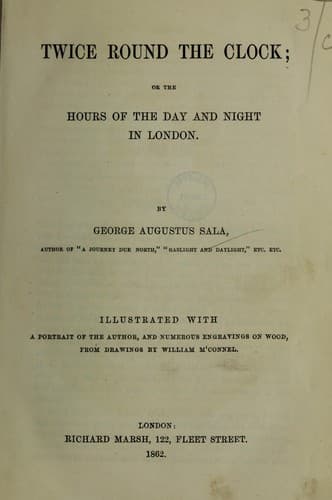
Twice round the clock; or, The hours of the day and night in LondonSala, George Augustus
General
Twice round the clock; or, The hours of the day and night in London
Sala, George Augustus
London (England) -- Social life and customs -- 19th century
What time the dock-labourers have finished lunch, another very
meritorious class of human ants begin their prandial repasts. With just
one thought at the vast number of merchants’, brokers’, shipping-agents’,
warehousemen’s, wholesale dealers’ counting-houses that exist in London
city, you will be able to form an idea of the legions of clerks, juniors
and seniors, who, invariably early-breakfasting men, must get seriously
hungry at one p.m. Some I know are too proud to dine at this patriarchal
hour. They dine, after office hours, at Simpson’s, at the Albion, at the
London, or, save us, at the Wellington. They go even further west, and
patronise Feetum’s, or the Scotch Stores in Regent Street, merely skating
out, as it were, for a few minutes at noon, for a snack at that Bay Tree
to which I have already alluded. Many, and they are the married clerks,
bring neat parcels with them, containing sandwiches or bread-and-cheese,
consuming those refreshments in the counting-house. In the very great
houses, it is not considered etiquette to dine during office-hours,
save on foreign-post nights. As to the extremely junior clerks, or
office-boys, as they are irreverently termed, they eat whatever they
can get, and whenever they can get it, very frequently getting nothing
at all. But there are yet hundreds upon hundreds of clerks who consume
an orthodox dinner of meat, vegetables, and cheese—and on high days
and holidays pudding—at one p.m. Their numbers are sufficient to cram
almost to suffocation the eating-houses of Cheapside, the Poultry, Mark
Lane, Cornhill, and especially Bucklersbury. Of late years there has
been an attempt to change the eating-houses of Cheapside into pseudo
“restaurants.” Seductive announcements, brilliantly emblazoned, and
showily framed and glazed, have been hung up, relating to “turtle” and
“venison;” salmon, with wide waddling mouths, have gasped in the windows;
and insinuating mural inscriptions have hinted at the existence of
“Private dining-rooms for ladies.” Now, whatever can ladies—though I have
the authority of Mr. Charles Dibdin and my own lips for declaring that
there are fine ones in the city—want to come and dine in Cheapside for?
At these restaurants they give you things with French names, charge you a
stated sum for attendance, provide the pale ale in silver tankards, and
take care of your hat and coat; but I like them not—neither, I believe,
do my friends, the one-o’clock-dining clerks. Either let me go to
Birch’s or the Anti-Gallican, or let me take my modest cut of roast and
boiled, my “one o’ taters,” my “cheese and sallary,” at an eating-house
in Bucklersbury—such a one as my _alter ego_, Mr. M’Connell, has here
presented for your edification. And his pictured morals must eke out my
written apophthegms—for this sheet is full.
TWO P.M.—FROM REGENT STREET TO HIGH CHANGE.
Public-domain text, read in full here on John Shaqi.
Reviews
Reviews
No reviews yet
Be the first to share your thoughts on this work.
Elsewhere in the archive
Join the Discussion
Join the discussion
Sign in to leave a comment or review.
Sign InorCreate an account