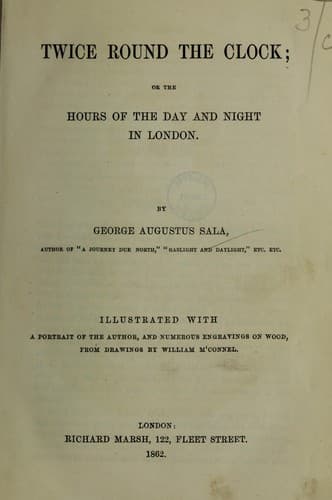
Twice round the clock; or, The hours of the day and night in LondonSala, George Augustus
General
Twice round the clock; or, The hours of the day and night in London
Sala, George Augustus
London (England) -- Social life and customs -- 19th century
My personal acquaintance with Regent Street dates from the year
’thirty-two, when I remember a great scrambling procession of operatives,
with parti-coloured flags, emblazoned with devices I could not read,
passing down it. Mrs. Esner, who was then attached to my person in a
domestic capacity (she often calls upon me now, and, saying that she
“nussed” me, expatiates on the benefits of a pound of green tea), told
me that these operatives belonged to the “Trades Union.” She said—though
the good woman must have exaggerated—that they were half a million in
number, and I recollect her portending, in a grave low voice, that there
would be riots that night. I don’t think that any occurred; but long
after, whenever I saw a crowd I used to ask whether “there would be any
riots” that night, just as I might have inquired whether there would be
any bread-and-butter for tea. This was about the time that they used to
call the great Duke of Wellington “Nosey,” and “Sawbones,” and to break
his windows. I was too young to know then, that the Athenians grew tired
of hearing Aristides called “The Just;” and that a nation once grumbled
at having to pay for the palace it had bestowed upon that John Churchill,
Duke of Marlborough, who won the battle of Blenheim. I think, too, there
must have been something about the Cholera in my earliest recollections
of Regent Street; yet, no: I lived in North Audley Street at that time,
and opposite the mansion of the great Earl of Clarendon; for, as clearly
as though it were yesterday, I see now in the eye to which the attention
of Horatio, friend of Hamlet Prince of Denmark, was directed—a hot autumn
afternoon. I am at the nursery-window in sad disgrace, and pouting
because I have wrenched the sprightly wooden hussar from the horse
which had the semi-circle of wire with the bullet at the end fixed in
his stomach, and who used, with that impetus, to swing so deftly. There
is much commotion in the great earl’s mansion; for one of the servants
partook too plentifully last night of gooseberry-fool after a rout his
lordship gave—where are the “routs” and the “gooseberry-fools” now?—and
she is dead this morning of cholera morbus. My female _entourage_ are
unanimously exacting in calling it cholera “morbus.” The undertaker’s men
bring the body out; the shell gleams white in the afternoon’s sunshine,
and it is begirt with cords; “for,” says the domestic oracles behind
me, “it was so mortal swole that it would ’ave bust else.” A horrible
rumour runs about, that the coffin has been “pitched and sealed.” What
can “pitching and sealing” mean? There is a great crowd before the
earl’s door, who are violent and clamorous, because rumour—a servant’s
hall, an area gate, a coachman from-the-house-to-his-wife-in-the-mews
rumour—bruits it about that the body has not been washed. My nurse says
that they will have to send for the “padroll” with “cut-lashes.” All
these things sink into my little mind; and then the whole sequel, with
Public-domain text, read in full here on John Shaqi.
Reviews
Reviews
No reviews yet
Be the first to share your thoughts on this work.
Elsewhere in the archive
Join the Discussion
Join the discussion
Sign in to leave a comment or review.
Sign InorCreate an account