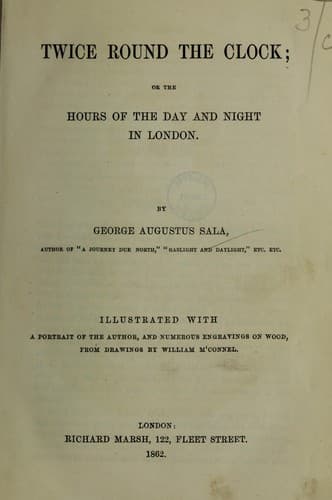
Twice round the clock; or, The hours of the day and night in LondonSala, George Augustus
General
Twice round the clock; or, The hours of the day and night in London
Sala, George Augustus
London (England) -- Social life and customs -- 19th century
a train of years behind it, fade away, leaving me with but one more
recollection—that we had a twopenny cottage-loaf boiled in milk that day
for dinner, which was consequently swollen to twice its natural size; and
which the Eumenides of the nursery authoritatively assured me was, with
brown sugar, the “best puddin’ out.” I know now that congested loaf to
have been an insipid swindle.
I am again in Regent Street, but at another window, and in another
house. There is no nurse now, but a genteel young woman, aged about
thirty—she asked me once, for fun, how old she was, and I guessed, in
all youthful seriousness, fifty, whereupon she slapped me—to take care
of me. Her name is Sprackmore, she has long corkscrew ringlets, and is
very pious, and beneath her auspices I first study the “Loss of the
_Kent_ East Indiaman,” and the “Dairyman’s Daughter.” She has fits,
too, occasionally. I am just of that age to be a hollow-eyed little boy
in a tunic, with a frill and a belt, and to be dreadfully afraid of
the parent I used a year before to love and caress with such fearless
confidence. They say I am a clever child, and my cleverness is encouraged
by being told that I am not to ask questions, and that I had much better
go and play with my toys than mope over that big volume of Lyttelton’s
“History of England,” lent to me by Mr. Somebody, the lawyer—I see him
now, very stout and gray, at the funeral whenever any of us dies: of
which volume—it is in very shabby condition—I break the top-cover off
by letting it fall from the chair, which is my reading-desk. I suffer
agonies of terror and remorse for months, lest the fracture should be
discovered, though I have temporarily repaired it by means of a gimlet
and a piece of twine. Then, one bright day, my cousin Sarah gives me a
bright five-shilling piece—I take her to the opera now, but she always
remembers my childish dependence upon her, and insists upon paying the
cab home—and take Lyttelton’s “History,” still with great fear and
trembling, to a bookbinder’s in Broad Street, Golden Square, who tells me
that the “hends is jagged,” and that there must be a new back, lettering,
and gilding to the book. He works his will with it, and charges me four
shillings and sixpence out of the five shilling-piece for working it; but
to tell of the joyful relief I feel when I bring Lyttelton’s “History”
back safe and sound! I do not get rid of my perturbation entirely,
however, till I have rubbed the back against the carpet a little to
soil it, in order that it may not look too new. Oh! the agonies, the
Laocoon-like conscience windings, the Promethean tortures, that children
suffer through these accidental breakages! Oh! the unreasoning cruelty
of parents, who punish children for such mischances! So I am the little
boy in a tunic; and I daresay that, with my inquisitiveness, and my
moping over books, I am an intolerable little nuisance. I am at the
Regent Street window, and much speculation is rife as to whether the
Public-domain text, read in full here on John Shaqi.
Reviews
Reviews
No reviews yet
Be the first to share your thoughts on this work.
Elsewhere in the archive
Join the Discussion
Join the discussion
Sign in to leave a comment or review.
Sign InorCreate an account