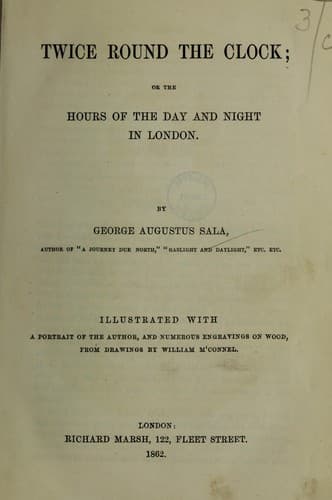
Twice round the clock; or, The hours of the day and night in LondonSala, George Augustus
General
Twice round the clock; or, The hours of the day and night in London
Sala, George Augustus
London (England) -- Social life and customs -- 19th century
The colonnades are as fruitful to me in recollections as the balconies.
How many miles of daily walks have I gone over, the hand of a toddling
little sister in mine, and with strict injunctions not to stray beyond
the shadow of the columns, and with prohibitions, under dreadful menaces,
of venturing in Air Street on the one side or Vigo Lane on the other!
I wore, I remember, then, an absurd blue cloak, too short for me, and
lined with red, and with a brass clasp somewhat resembling the ornament
on a cartouch box. This cloak chafed and fretted me, and was the bane
and terror of my existence; for I knew, or fancied I knew, that every
passer-by must know that it had never been made for me, which, indeed,
it never had, having formerly been of far larger dimensions and the
property of an officer in his Majesty’s light infantry. I believe that
there was a domestic ukase promulgated for our benefit against crossing
the road; but we did cross it nevertheless, with many looks to the right
and the left, not only to secure ourselves against threatening carriage
wheels, but with reference to the possible appearance of parents and
guardians. There was a delightful bird-stuffer’s shop at the corner of
a court, with birds of paradise, parrots, and hummingbirds of gorgeous
plumage, and strange creatures with white bodies and long yellow beaks
and legs that terrified while they pleasured us. Then there was the
funeral monument shop, with the mural tablets, the obelisks, the broken
columns, the extinguished torches, and the draped urns in the window,
and some with the inscriptions into the bargain, all ready engraved in
black and white, puzzling us as to whether the tender husbands, devoted
wives, and affectionate sons, to whom they referred, were buried in
that grisly shop—it had a pleasant, fascinating terror about it, like
an undertaker’s, too. There was Swan and Edgar’s, splendid and radiant,
then as now, with brave apparel (how many times have I listened to the
enthusiastic cheers of Swan and Edgar’s young men, on the occasion of
the proprietors giving their annual banquet to their _employés_?), and
even then replete with legends of dishonest fares, who caused a cab to
halt at the Regent Street entrance, got out, said they would be back
in a moment, and then darting through the crowded shop, knavishly
escaped at the Piccadilly end. There was the Italian statuary shop, with
Canova’s Graces, the crouching Venus, and the birds round a vase in
alabaster; and, above all, there was Mrs. Lipscombe’s shop—I don’t mean
the staymaker’s, but the one next to that, the filter shop, with the
astonishing machines for converting foul and muddy water, like gruel,
thick and slab, into a sparkling, crystal stream. What a miracle it
seemed to me that the goblet, filled to the brim, and yet into which,
from the filter above, drops continually fell, never overflowed! How I
used to watch the little cork ball, kept in a continually bounding state
Public-domain text, read in full here on John Shaqi.
Reviews
Reviews
No reviews yet
Be the first to share your thoughts on this work.
Elsewhere in the archive
Join the Discussion
Join the discussion
Sign in to leave a comment or review.
Sign InorCreate an account