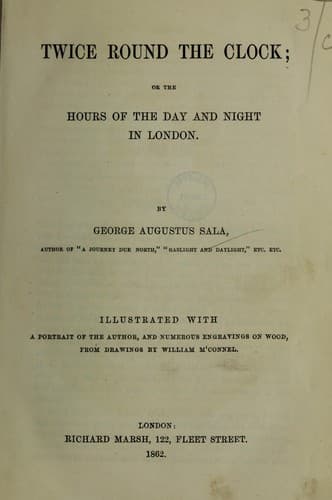
Twice round the clock; or, The hours of the day and night in LondonSala, George Augustus
General
Twice round the clock; or, The hours of the day and night in London
Sala, George Augustus
London (England) -- Social life and customs -- 19th century
encircled his invaluable throat when he took out-door exercise. I have
seen, through his open window, the basso of basso’s, Papa Lablache, the
man with the lion’s head, the Falstaffian abdomen, and the ten times
stentorian lungs, eat maccaroni for twenty-seven consecutive minutes,
till he seemed determined to outdo all the ribbon-swallowing conjurors
who had ever lived. We used to say that he was practising for Leporello.
He had a kindly heart, Papa Lablache, and preserved a kindly remembrance
of the hearty English people, among whom he made his fortune. Though he
would sometimes facetiously declare, that when his voice was no longer
fit to be heard in a Continental city, he would come to England to
settle, and sing “_Fra questi sordi_” among these deaf ones—for whom
he would still be quite good enough—his heart never cooled towards the
old country; and, moribund at Naples, when the supreme Hour was fast
arriving, he raised himself on his couch, and essayed to sing a song he
loved very well—“Home! sweet Home!” But, as the silver cord loosened, he
murmured, “_Mi manca la voce_”—“My voice fails me;” and so died.
To say nothing of a dreadful German basso, one of the regular
line-of-battle ship voices, with 56-pounders on the first deck, who was
once a next-door neighbour in the Quadrant, and when he used to call for
his servant thus,“PAOOLO!” shook the flower-pots on our own balcony;
or of an egregious fiddler, with long hair, who, in imitation of his
predecessor, Paganini, gave out that he had sold himself to the devil,
but who was, I believe, an arrant humbug with a mania for practising in
the open air—it may have been as a medium of advertisement—and used to
attract large crowds in the street beneath listening to his complicated
fiddlements. Yet I must spare a word for Madame—I really forget whom, but
it ended with “heim,” I think—who had the six-and-thirty Austro-Sclavonic
children who used to perform the mirror dance and other terpsichorean
feats at her Majesty’s Theatre and whom she used to drill on the balcony
like soldiers. They made a tremendous noise, these tiny _figurantes_,
and in the hours of recreation were not unaccustomed to fight among
themselves. Then Madame Somethingheim would sally forth on the balcony
and cut savagely into their poor young bodies with a switch, and after
much howling on their part, and chasing to and fro on hers, restore peace.
Public-domain text, read in full here on John Shaqi.
Reviews
Reviews
No reviews yet
Be the first to share your thoughts on this work.
Elsewhere in the archive
Join the Discussion
Join the discussion
Sign in to leave a comment or review.
Sign InorCreate an account