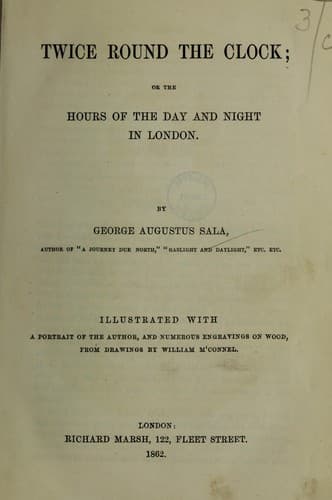
Twice round the clock; or, The hours of the day and night in LondonSala, George Augustus
General
Twice round the clock; or, The hours of the day and night in London
Sala, George Augustus
London (England) -- Social life and customs -- 19th century
Miserable dogs mostly, for
all their fine clothes—always resplendently, though dirtily, attired.
They wore great white coats, shiny hats, and mosaic jewellery, which was
just then coming into fashion. There was another fashion, in which they
very nearly succeeded, by adopting, to drive out, and make permanently
disreputable: that of wearing moustaches. They used to swagger about, all
lacquered, pomatumed, bejewelled, and begrimed, till I knew them all by
sight and many of them by name and repute. There was Jack Cheetham, the
lord’s son, he who was thrown out of the window at Frascati’s, and killed
the Frenchman in the Bois de Vincennes. There was Captain Dollamore,
who married the rich widow, and was arrested for her milliner’s bill
the week afterwards. There was Charley Skewball; he was called Charley,
but he was a baronet, had once been a gentleman, and was the greatest
rogue unhung. Mr. Thackeray knows these men well. They are his Count
Punters, Major Loders, M. de Caramboles, Hon. Algernon Deuceaces; but
they are extinct among us as a class, O Titmarsh; and simple people, who
read your admirable novels, wonder whom the monsters are that you draw.
They are dead; they are at the hulks; they are feebly punting at the few
remaining gambling places on the Rhine: they flaunted in the bad prime
of their manhood when I was a child. I have outgrown them; and only now
and then, when I am out very late, collecting materials for “Twice Round
the Clock,” I come upon a stray Jack or Charley—ragged and drivelling,
his fine feathers all moulted or smirched, his occupation quite gone—who
sidles up to me and calls me “Your honour,” and with salt-rheumy lips,
whimpers forth a supplication for “A penny towards a night’s lodging.”
When our dear Queen Victoria was crowned, I began to lose sight of Regent
Street—lost sight of it by degrees altogether, and came not back to it,
as an observer, for many years. I rather avoided the place, for I had a
bitter baptism of physical misery in the beginning of my working life:
wanting food and raiment, not through prodigality (that came afterwards),
but through sheer penury and friendlessness. And Regent Street, for all
my querulous childhood, was associated with too many memories of happier
days gone for ever. You know what the Italian rhymester says—
“Nessun maggior dolore
Che ricordarsi del tempo felice
Nella Miseria.”
Public-domain text, read in full here on John Shaqi.
Reviews
Reviews
No reviews yet
Be the first to share your thoughts on this work.
Elsewhere in the archive
Join the Discussion
Join the discussion
Sign in to leave a comment or review.
Sign InorCreate an account