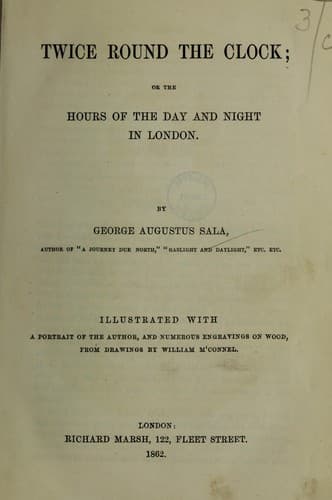
Twice round the clock; or, The hours of the day and night in LondonSala, George Augustus
General
Twice round the clock; or, The hours of the day and night in London
Sala, George Augustus
London (England) -- Social life and customs -- 19th century
An Englishman has stolen the thought in some lines about “a sorrow’s
crown of sorrow,” whose summing up I forget; but the sense of the passage
is that the times are exceedingly hard, when, destitute and footsore, you
pass by a house, and glance at the windows once lighted up by feasting
in which you participated; when you think of the rooms, once swept by
the robe of the woman whom you loved, but that now, house, windows,
rooms, are the portion of strangers. I say I went away from Regent
Street, and came not back. There were reasons. I became of the Strand
and Fleet Street a denizen, and Temple Bar entered into my soul. For I
was affiliated to a great mystery of Masonry, called Literature, and had
to follow the behests of my mother lodge. You don’t see much of Regent
Street, during your apprenticeship, if you begin at the lowermost degree,
I can assure you. Now I am a master-mason, free and accepted, and can
hold my own; albeit I shall never be an Office-bearer, or “Grand,” of my
lodge, or rise to the superlatives of the Royal Arch or the Thirty-third.
Behold Regent Street at two p.m., in the accompanying cartoon. Not
without reason do I declare it the most fashionable street in the world.
I call it not so for the aristocratic mansions it might possess; for
the lower parts of the houses are occupied as shops, and the furnished
apartments are let, either to music or operatic celebrities or to
unostentatious old bachelors. But the shops themselves are innately
fashionable. There was a dash of utilitarianism mingled with the slightly
Bohemian tinge of my Regent Street of twenty years ago; there were
bakers’ shops, stationers, and opticians, who had models of steam engines
in their windows. There was a grocer not above selling orange marmalade,
brown sugar, and Durham mustard. I remember buying a penny cake of
chocolate of him one morning; but I find the shop now expanded into a
magnificent emporium, where are sold wines, and spirits, sweetmeats
and preserves, liqueurs and condiments, Bayonne ham, Narbonne honey,
Bologna sausages, Russian caviare, Iceland moss, clotted cream, and
_terrines_ of _pâté de foie gras_. Indeed, Regent Street is an avenue
of superfluities—a great trunk-road in Vanity Fair. Fancy watchmakers,
haberdashers, and photographers; fancy stationers, fancy hosiers, and
fancy staymakers; music shops, shawl shops, jewellers, French glove
shops, perfumery, and point lace shops, confectioners and milliners:
creamily, these are the merchants whose wares are exhibited in this
Bezesteen of the world.
[Illustration: TWO O’CLOCK P.M.: HIGH CHANGE.]
Public-domain text, read in full here on John Shaqi.
Reviews
Reviews
No reviews yet
Be the first to share your thoughts on this work.
Elsewhere in the archive
Join the Discussion
Join the discussion
Sign in to leave a comment or review.
Sign InorCreate an account