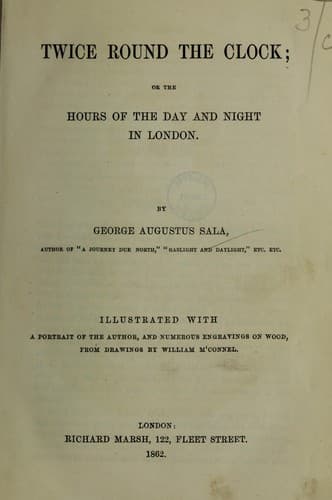
Twice round the clock; or, The hours of the day and night in LondonSala, George Augustus
General
Twice round the clock; or, The hours of the day and night in London
Sala, George Augustus
London (England) -- Social life and customs -- 19th century
Now, whatever can her ladyship, who has been shopping in Regent Street,
have ordered the stalwart footman, who shut the carriage door with a
resounding bang, to instruct the coachman to drive her to the Bank for?
Her ladyship’s own private bank is in a shiningly aristocratic street,
by Cavendish Square, embosomed among green trees. She does not want to
buy ribbons or lace on Ludgate Hill, artificial flowers in St. Paul’s
Churchyard, or fine linen in Cheapside. No; she has a very simple reason
for going into the city: Sir John, her liege lord, is on ’Change. He will
be there from half-past two to three, at which hour High ’Change, as it
may be called, closes, and she intends to call for him, and drive him to
the West-end again. By your leave, we will jump up behind the carriage,
heedless of the stalwart footman; for we are in the receipt of fern-seed,
and invisible.
Going on ’Change seems to be but a mechanical and mercantile occupation,
and one that might with safety be entrusted to some confidential clerk;
yet it is not so; and the greatest magnates of commerce and finance,
the Rothschilds, the Barings, the Huths, the legions of London’s
merchant-princes, are to be found chaffering in the quadrangle every
day. In the old Exchange, they used to point out the particular column
against which the elder Rothschild was wont to lean. They called the old
man, too—marvellous diplomatist in financial combinations as he was—the
Pillar of the Exchange. You know that the colonnades—whose ceilings are
painted in such elaborate encaustic, and with such a signal result in
ruin from damp and smoke—are divided into different promenades, variously
designated, according to the nations of the merchants who frequent them.
Thus—there are the Italian Walk, the Spanish Walk, the Portuguese Walk,
the Danish Walk, and—a very notable walk it is too—the Greek Walk.
Here you may see, jabbering and gesticulating, the crafty, keen-eyed,
sallow-faced Smyrnians, Suliotes, Zantrites, and Fanariotes, individuals
much given to speculations in corn, in which, if report does them no
injustice, they gamble most egregiously.
Public-domain text, read in full here on John Shaqi.
Reviews
Reviews
No reviews yet
Be the first to share your thoughts on this work.
Elsewhere in the archive
Join the Discussion
Join the discussion
Sign in to leave a comment or review.
Sign InorCreate an account