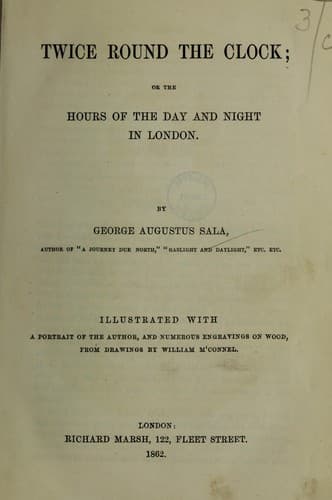
Twice round the clock; or, The hours of the day and night in LondonSala, George Augustus
General
Twice round the clock; or, The hours of the day and night in London
Sala, George Augustus
London (England) -- Social life and customs -- 19th century
I have been led into this train of thought by the contemplation of the
exigencies of “Twice Round the Clock.” Time, my slave for once, though
he has been my stern and cruel master for years and years, and at whom I
mean to throw a dart when this series shall be completed—Time, who is my
bond servant, to fetch and carry, to hew wood and draw water for yet a
span, has culled from the wild garden of Eternity, and thrown at my feet,
a heterogeneous mass of hours, minutes, and seconds, and has said with a
mocking subserviency—“There, my master, there are the hours of the day
and night, and their minutest subdivisions; try and paste them on your
printed calendar; try and reconcile your men and women to them; try and
apportion in its proper measure of time each grain of sand to the futile
rivings and strivings of your conceited humanity. You have stumbled on
from hour to hour since the sun was young, telling, with indifferent
success, the good and bad deeds that are done in London as the relentless
needle pushes round and round the dial. Here, then, is Three o’Clock
in the Afternoon. Take it; see what you can make of it, and much good
may it do you!” And as Time, or the vagrant thought I have embodied for
the nonce, says this, he sticks his tongue into his cheek, as though he
thought that three o’clock in the afternoon were rather a poser to me.
Old man with the scythe and hour-glass, I defy thee! I will admit that
three o’clock post meridian, requires much deliberation and cogitation,
in order to give the millions of human marionettes, of whom I hold,
temporarily, the strings, their suitable employment; but it is rather
from a profusion than a paucity of scenes and things germane to the
hour that I am embarrassed. At three, ’Change is still going on, though
its busy time, the acmè of its excitement, is over. As the clock
strikes four, the city of London is in full pant; the clerks rush up
Cheapside, and dive down the wealthy narrow lanes, their bursting
bill-books (secured by leather-covered chains tied round their bodies)
charged with “three months after date, please pay to the order,”
which they cram into letter-boxes for acceptance. The private banking
houses in Lombard Street are in an orderly uproar of finance. The
rattling of shovels is incessant; office-boys cast thousands of pounds,
in notes, bills, and money, to the cashier, carelessly, across the
counter, paying vast sums in to their masters’ accounts; and the mighty
partners—in checked neckerchiefs, buff waistcoats, and creaking boots:
tremendous bank-partners, who are baronets, and members of Parliament,
lords even—stalk back from ’Change, pay a farewell visit to the bank
parlour, have a short but solemn confab with confidential subordinates,
relative to coming transactions at the clearing-house, and then enter
their carriages, and are borne to clubs, to the House of Commons, to
Greenwich dinners, or, perchance, if they have a dinner-party at home,
Public-domain text, read in full here on John Shaqi.
Reviews
Reviews
No reviews yet
Be the first to share your thoughts on this work.
Elsewhere in the archive
Join the Discussion
Join the discussion
Sign in to leave a comment or review.
Sign InorCreate an account