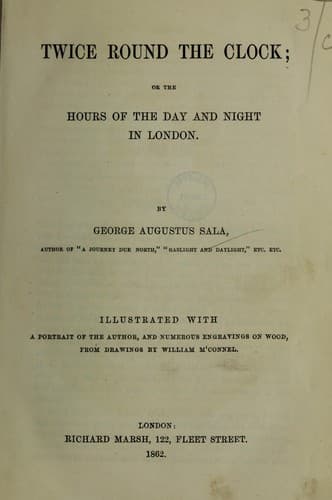
Twice round the clock; or, The hours of the day and night in LondonSala, George Augustus
General
Twice round the clock; or, The hours of the day and night in London
Sala, George Augustus
London (England) -- Social life and customs -- 19th century
to their magnificent villas at Putney and Roehampton. What a colony
of bankers dwell there! the _sommités_ of the _haute finance_ seem to
entertain as decided a partiality for the banks of the Thames, as the
stockbrokers do for Brixton and Tulse Hill. Rare lives these money
keepers lead—scattering in the West that which they gather in the East.
Graperies, pineries, conservatories, ice-houses, dinner-parties, balls,
picnics; all these do they enjoy: they, their comely wives and handsome
daughters. They marry into the aristocracy! they have countesses and
marchionesses in their list of partners. It is not so many centuries
ago since the bankers were humble sellers of gold plate, dwelling in
Lombard Street and the Chepe, and following the great courtiers round the
quadrangle of the Exchange, intreating their lordships’ honours to be
allowed to keep their cash. Worthy individuals, however, are the majority
of these bankers, and it is but very rarely indeed that they make ducks
and drakes of their customers’ moneys. They are not so very proud either,
for all their splendid carriages and horses; and here, upon my word, is
Baron Lionel de Rothschild tearing up Ludgate Hill in a common Hansom
cab; but he, like the bad man whom Martial in an epigram declares not to
be so much vicious as vice itself, is less a Banker than a Bank.
As three o’clock grows old, and the tide of business shows unmistakeable
indices of an ebb at no very remote period, so far as the city is
concerned, that same business is at the West-end in its extremest
activity. The shops of the West Strand, Piccadilly, Oxford and Regent
Streets, are thronged with customers, chiefly ladies; the roadway
is encumbered with carts and carriages; and street avocations—the
minor commerce of the mighty mart—are in full swing. Thick-necked and
beetle-browed individuals, by courtesy called dog-fanciers, but who
in many cases might with as much propriety answer to the name of
dog-stealers—forbidding-looking gentry, in coats of velveteen, with large
mother-o’-pearl buttons, and waistcoats of the neat and unpretending
moleskin—lurk about the kerbs of the purlieus of Regent Street and
Waterloo Place (the police drive them away from the main thoroughfares),
with the little “dawgs” they have to sell tucked beneath their arms, made
doubly attractive by much washing with scented soap, and the further
decoration of their necks with pink or blue ribbons. Here is the little
snub-nosed King Charles—I hope the _retroussé_ appearance of his nasal
organ is not due to the unkind agency of a noose of whipcord—his feathery
feet and tail, and his long silky ears, sweeping the clean summer
pavement. Here is the Newfoundland pup, with his bullet head and clubbed
caudal-appendage, winking his stupid little eyes, and needing, seemingly,
an enormous amount of licking into shape. Here is the bull-dog, in his
full growth, with his legs bowed, his tail inclining to the spiral, his
Public-domain text, read in full here on John Shaqi.
Reviews
Reviews
No reviews yet
Be the first to share your thoughts on this work.
Elsewhere in the archive
Join the Discussion
Join the discussion
Sign in to leave a comment or review.
Sign InorCreate an account