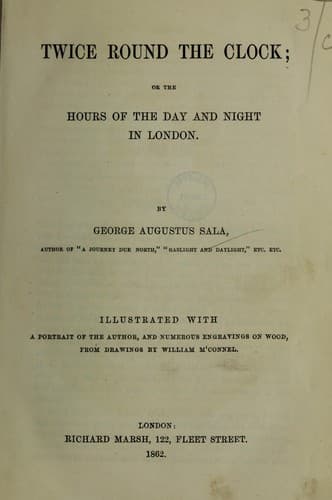
Twice round the clock; or, The hours of the day and night in LondonSala, George Augustus
General
Twice round the clock; or, The hours of the day and night in London
Sala, George Augustus
London (England) -- Social life and customs -- 19th century
and they were bare, plump, and mottled) that excited his carnivorous
propensities, for, long as is the lapse of time, I remember that he
rushed at me like a coffee-coloured tiger. His mistress was a Duchess,
the grandest, handsomest Duchess that had ever lived (of course, I except
Georgina of Devonshire) since the days of that Grace of Queensberry
of whom Mr. Thackeray was good enough to tell us in the “Virginians.”
She, my Duchess, wore a hat and feathers, diamonds, and a _moustache_—a
downy nimbus round her mouth, like that which Mr. Philip insinuates
rather than paints in his delightful Spanish girls’ faces. I see her
now, parading the cliff at Brighton, with her black velvet train—yes,
madam, her train—held up by a page. She was the last duchess who drove
down to Brighton in a coach and six. She was the last duchess who at
Twelfth-night parties had a diamond ring baked in the cake which was to
be distributed by lots. Before she came to her coronet, she had been a
singing woman at a playhouse, had married a very foolish rich old banker,
and, at his death, remarried a more foolish and very poor duke. But she
was an excellent woman, and the relative to whom she left the bulk of her
wealth, is one of the most charitable, as I am also afraid she is one of
the most _ennuyée_, ladies in England. I am proud of my reminiscence. It
is not every one that has seen a Dutch pug and the Duchess of St. Albans
alive.
Body of me! here am I wasting my time among the dog-fanciers—(when
the name of the man in the iron mask, the authorship of “Junius,” the
murderer of Caspar Hauser, and the date of the laws of Menu, shall be
known, it shall also be patent to all men why trafficking in dogs and
horses seem necessarily connected with roguery)—here am I descanting
on poodles and pug-dogs, when, with quick observant eyes, I should be
noting the hundred little trades that are being driven at three o’clock
in the afternoon. The feverish industry—the untiring perseverance—the
bitter struggle, and all for yon scanty morsel of bread, and a few
inches of space for repose at night in a fourpenny lodging-house! Follow
the kerb-stone from the County Fire Office to St. Martin’s Lane. See
the itinerant venders of catch-’em-alive-o’s, of cheap toys, of quires
of writing-paper, sealing-wax and envelopes, all for the small charge
of one penny; see the industrials who have walking-sticks, umbrellas,
gutta-percha whips, aërated balls, locomotive engines and statuettes
of Napoleon in glass phials, that make us wonder, as with flies in
amber, however they, the engines and statuettes, got there; the women
who have bouquets to dispose of—how many times have they been refreshed
beneath the pump, this droughty day?—the boys and girls in looped and
windowed raggedness striving to sell fruit, flowers, almanacks, pencils,
fusees—anything, to keep the wolf from the door. He is always at the
door, that wolf—always at that yawning portal, and his name is Famine.
Public-domain text, read in full here on John Shaqi.
Reviews
Reviews
No reviews yet
Be the first to share your thoughts on this work.
Elsewhere in the archive
Join the Discussion
Join the discussion
Sign in to leave a comment or review.
Sign InorCreate an account