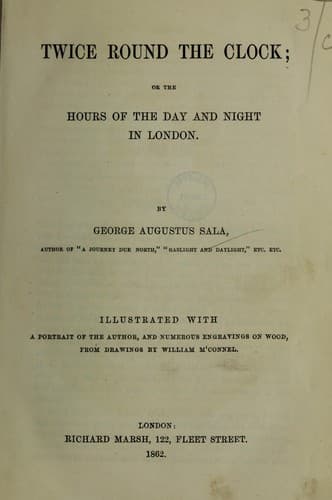
Twice round the clock; or, The hours of the day and night in LondonSala, George Augustus
General
Twice round the clock; or, The hours of the day and night in London
Sala, George Augustus
London (England) -- Social life and customs -- 19th century
broad chest, thin flanks, defined ribs, moist nozzle, hare lip, bloodshot
eyes, protruding fang, and symmetrical patch over one eye; or else, in
a state of puppyhood, peeping from his proprietor’s side-pocket, all
pink and white like a morose sucking-pig become a hermit. Here is the
delightful little toy English terrier, with his jet-black coat, erect
neck, and tan paws; and here the genuine Skye, gray or brown, like an
unravelled ball of worsted. See, too, grimacing at all who come to view,
like a mulatto at a slave auction, who fancies himself good-looking, the
accomplished French poodle, with his peaked nose, woolly wig, leggings,
and tail band, and his horrible shaved, salmon-coloured body. He can
dance; he can perform gun-drill; he can fall motionless, as though dead,
at the word of command; he can climb up a lamp-post, jump over a stick,
hop on one leg, carry a basket in his mouth, and run away when he is
told that a policeman is coming. You can teach him to do anything but
love you. These, and good store of mongrels and half-breeds that the
dealer would fain palm upon us as dogs of blood and price, frisk and
fawn about his cord-trouser covered legs; but where is the toy-dog _par
excellence_, the playful, snappish, fractious, facetious, charming,
utterly useless little dog, that, a quarter of a century since, was the
treasure of our dowagers and our old maids? Where is the Dutch pug? Where
is that Narcissus of canine Calibanism, with his coffee-coloured coat,
his tail in a ring like the blue-nosed baboon’s, his crisped morsels of
ears, his black muzzle, his sharp, gleaming little teeth, his intensely
red lips and tongue? Is he extinct, like the lion-dog from Malta, the
property of her Majesty the Queen, and the “last of his race,” whom
courtly Sir Edwin Landseer drew? Are there no more Dutch pugs? They must
exist somewhere. Cunning dealers owning _recherché_ kennels in the New
Road or at Battle Bridge, or attending recondite “show clubs,” held at
mysterious hostelries in the vicinity of Clerkenwell, must yet have some
undoubted specimens of the pug for sale. There must be burghers yet, in
the fat comfortable houses at Loo by the Hague, or in the plethoric,
oozy vicinage of Amsterdam—there must be Tietjens, and Tenbroecks,
and van Ramms, and van Bummels, whose pride it is, amidst their store
of tulip bulbs, china vases, cabinet pictures by Breughel and Ostade,
lacquer-work from Japan, and spice-boxes from Java, to possess Dutch
pugs in the flesh. But the creature is seen no more in London streets,
and we must be content with him on Hogarth’s canvases, in Linacre’s
engravings, or modelled in china, as we see him in the curiosity shops.
I have indeed seen the elephant—I mean the Dutch pug—alive and snarling,
once in my life. He was led by a bright scarlet ribbon—scarlet, mind,
not pink or blue—attached to his silver collar; and there must have
been something in the appearance of my youthful legs (I was but five,
Public-domain text, read in full here on John Shaqi.
Reviews
Reviews
No reviews yet
Be the first to share your thoughts on this work.
Elsewhere in the archive
Join the Discussion
Join the discussion
Sign in to leave a comment or review.
Sign InorCreate an account