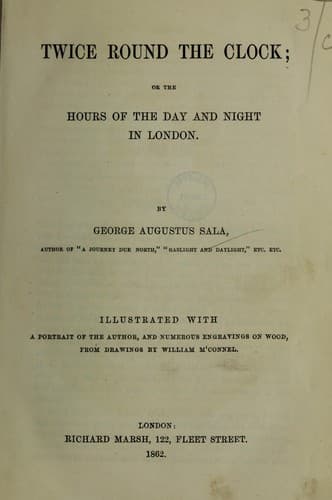
Twice round the clock; or, The hours of the day and night in LondonSala, George Augustus
General
Twice round the clock; or, The hours of the day and night in London
Sala, George Augustus
London (England) -- Social life and customs -- 19th century
pocketbooks they draw greasy documents, faded envelopes, sleezy letters,
which have been folded and refolded so often that they seem in imminent
danger of dropping to pieces like an over-used passport at the next
display. With what an owl-like, an oracular, look of wisdom they consult
these papers! What are they all about? The bankruptcy of their owners
thirty years ago, and the infamous behaviour of the official assignees
(dead and buried years since)? their early love correspondence? their
title-deeds to the estates in Ayrshire, and the large pasture lands in
the Isle of Skye? Who knows? But you never see these ghostly time-waiters
anywhere but on ’Change, and out of ’Change hours. Directly the
legitimate business of that place of commercial re-union commences, they
melt away imperceptibly, like the ghost of Hamlet’s father at cock-crow,
coming like shadows and so departing.
The dreadful night dens and low revelling houses of past midnight London,
the only remnants left among us of the innumerable “finishes” and
saloons and night-cellars of a former age, have also their peculiar male
population, stamped indelibly with the mint-mark of the place, and not to
be found out of it, save in the dock of the adjacent police-court. Where
these _ruffiani_, these copper captains and cozening buz-gloaks, are to
be found during the day, or even up to midnight—for in the gallery even
of any decent theatre they would not be admitted—must remain a secret;
perhaps, like the ghoules and afrits, the bats and dragons of fable,
they haunt ruinous tombs, deserted sepulchres, church-yards sealed up
long since by the Board of Health; but so soon as two or three o’clock
in the morning arrives, they are to be found wherever there are fools to
be fleeced or knaves to plot with. You study their lank hair and stained
splendid stocks, their rumpled jay’s finery and rascal talk, their cheap
canes and sham rings; but they, too, fade away with the dawn—how, no
man can say, for the meanest cabman would scorn to convey them in his
vehicle—and are not beheld any more till vagabondising time begins again.
Public-domain text, read in full here on John Shaqi.
Reviews
Reviews
No reviews yet
Be the first to share your thoughts on this work.
Elsewhere in the archive
Join the Discussion
Join the discussion
Sign in to leave a comment or review.
Sign InorCreate an account