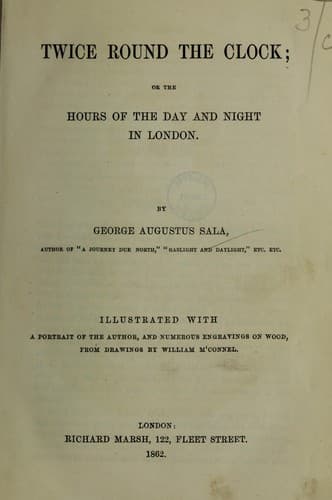
Twice round the clock; or, The hours of the day and night in LondonSala, George Augustus
General
Twice round the clock; or, The hours of the day and night in London
Sala, George Augustus
London (England) -- Social life and customs -- 19th century
Before, however, you come to the Garrick, before you come to the
coffee-shop where there is that strange collection of alarming-looking
portraits; before you come to Mr. Kilpack’s cigar divan and
bowling-alley, you arrive at the door of an unpretending, though roomy
mansion, the jambs of whose portals are furnished with flattering
catalogues relative to “this day’s sale,” and the pavement before whose
frontage is strewn with fragments of straw and shreds of carpeting. It is
strange, too, if you do not see half a dozen or so burly-looking porters
lounging about the premises, and a corresponding number of porter’s
knots, the straw stuffing bulging occasionally from rents in their
sides, decorating the railings, as the pint pots do the iron barriers of
the licensed victuallers. This mansion contains the great auction-room
of Messrs. Debenham and Storr. Let us enter without fear. There is
scarcely, I think, so interesting an exhibition in London; yet, in
contradistinction to the majority of London exhibitions, there is nothing
to pay.
In this monstrous amalgam of microcosms, London, a man may, if he
will only take the trouble, find that certain places, streets, rooms,
peculiar spots and set apart localities, are haunted by classes of people
as peculiar as the localities they affect, and who are seldom to be
found anywhere else. In the early forenoon, long before business hours
commence, the benches of the piazza of the Royal Exchange have their
peculiar occupants—lank, mystic-looking men, mostly advanced in years,
and shiny in threadbare blackclothdom. They converse with one another
seldom, and when they do so, it is but in furtive whispers, the cavernous
mouth screened by the rugose hand, with its knotted cordage of veins and
its chalkstoned knuckles, as though the whisper were of such commercial
moment that the locutor feared its instantaneous transport to the ears
of Rothschild or Baring, and the consequent uprising or downfalling
of stocks or corn, silk or tallow. Who are these men, these Exchange
ghosts, who haunt the site of Sir Thomas Gresham’s old “Burse?” Are they
commission agents come to decay, bankrupt metal brokers, burnt-out,
uninsured wharfingers, lame ducks of the Stock Exchange, forced even
to “waddle” from the purlieus of Capel Court? There they sit day after
day—their feet (lamentably covered with boots of fastidious bigness, for,
alas! the soles are warped, the sides crack, the heels are irrevocably
lopsided) beating the devil’s tattoo on the stone pavement, their big
cotton umbrellas distilling a mouldy moisture, or a pair of faded Berlin
gloves, quite gone and ruined at the fingers, lying on the bench beside
them. Their battered hats oscillate on their heads through overloading
with tape-tied papers, and oft-times, from the breast-pocket of their
tightly-buttoned coats, they drag leathern pocketbooks, white and frayed
at the edges like the seams of their own poor garments, from which
Public-domain text, read in full here on John Shaqi.
Reviews
Reviews
No reviews yet
Be the first to share your thoughts on this work.
Elsewhere in the archive
Join the Discussion
Join the discussion
Sign in to leave a comment or review.
Sign InorCreate an account