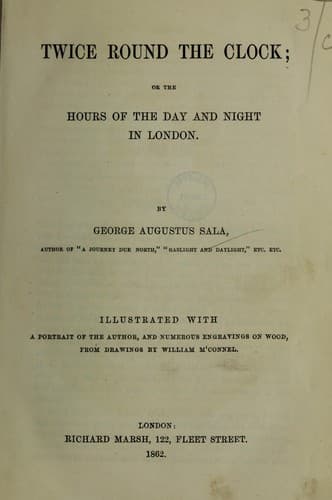
Twice round the clock; or, The hours of the day and night in LondonSala, George Augustus
General
Twice round the clock; or, The hours of the day and night in London
Sala, George Augustus
London (England) -- Social life and customs -- 19th century
Was there not a time when Hyde Park Corner was the Ultima Thule of
London, and Kensington was in the country?—when Hammersmith was far
away—a district known only to washerwomen and nursery gardeners—and
Turnham Green and Kew were places where citizens took their wives to
enjoy the perfection of ruralisation? Was it not to the Hercules’ Pillars
at Hyde Park Corner that Squire Western sent his chaplain to recover the
snuff-box, which the worthy landed-gentleman and justice of the peace had
left there when he halted to bait? Was not Hyde Park Corner a rendezvous
for highwaymen, where they listened with eagerness for “the sound of
coaches;” and parted, some towards Fulham, some towards Hounslow, some
towards the Uxbridge road, where they might meet full-pouched travellers,
and bid them “stand and deliver?” I remember, myself, old Padlock House
at Knightsbride, standing in the midst of the roadway, like Middle Row
in Holborn, or the southern block of Holywell Street in the Strand,
with the padlock itself fixed in the grimy wall, which, according to the
legendary wishes of a mythical testator, was never to be pulled down till
the lock rotted away from its chain, and the chain from the brick and
mortar in which it was imbedded. The cavalry barracks at Knightsbride
seemed to have been built in the year One, and we boys whispered that
the little iron knobs on the wall of the line of stables, which are, it
is to be presumed, intended for purposes of ventilation (though I am
not at all certain about the matter yet) were miniature portholes, at
which fierce troopers, with carbines loaded to the muzzle, and ready
pointed, kept guard every day, in order to repel the attacks of the
“Radicals.” Alack-a-day! but the “Radicals” seem to be getting somewhat
the better of it at this present time of writing. Kensington High Street
seemed to belong to a hamlet of immense age; the old church was a very
cathedral—built, of course, by William of Wykeham; and as for Holland
House, there could not be any doubt about that. It came in naturally with
the Conqueror, and the first Lord Holland.
Public-domain text, read in full here on John Shaqi.
Reviews
Reviews
No reviews yet
Be the first to share your thoughts on this work.
Elsewhere in the archive
Join the Discussion
Join the discussion
Sign in to leave a comment or review.
Sign InorCreate an account