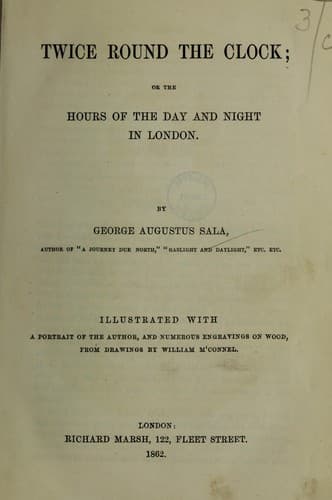
Twice round the clock; or, The hours of the day and night in LondonSala, George Augustus
General
Twice round the clock; or, The hours of the day and night in London
Sala, George Augustus
London (England) -- Social life and customs -- 19th century
I don’t exactly know how far the English club-shoot has been grafted on
the trunk of American society, but I can’t believe that the club-proper
flourishes there to any great extent. I like the Americans much,
recognising in them many noble, generous, upright, manly qualities; but I
am afraid they are too fond of asking questions—too ignorant or unmindful
of the great art of sitting half an hour in the company of a man whom
you know intimately, without saying a word to him, to be completely
clubable. Moreover, they are a people who drink _standing_, delighting
much to “liquor up” in crowded bar-rooms, and seldom sitting down to
their potations—a most unclubable characteristic. All sorts of convivial
and political _réunions_ exist, I am aware, in the United States, to
a high degree of organisation; and I have heard glowing accounts of
the comfortable, club-like guard-rooms and stations of the New York
volunteers and firemen; but I can’t exactly consider these in the light
of clubs. They are not exclusive enough—not concrete enough—not subject
to the rigid but salutary discipline of that _Imperium in Imperio_, or
rather, _Rempublicam in Republicâ_, the committee of a club.
In England, the Ancient Order of Druids were undeniably the first
clubmen, keeping things remarkably snug, and delighting much in
house-dinners at the sign of the Misletoe, where a roasted Ancient Briton
was no rare dish. It might aid, too, to clear up the puzzling enigma
of Stonehenge—who built it, and how, and why?—if we were to look upon
Druidism in a purely club-light. I should like to know whence the money
came which the Megatherium or the Mastodon Clubs in Pall Mall cost to
build. We know that Captain Threadbare, late of the Rifles, that the
Hon. Jemmy O’Nuffin, respectively members of those grand _cénacles_,
didn’t find the money; that they never paid anything towards their clubs,
save the entrance fee and the subscription; and that they dine there,
nine months out of the year, for eighteen-pence. Other members did,
do, will do the same; yet there the club stands, stately and superb,
with its columns of multi-coloured marbles, its stately halls, its
sumptuous furniture, its army of liveried lacqueys. A belted earl might
ruin himself in building such a mansion; yet Captain Threadbare and
Jemmy O’Nuffin call it their club, and it is theirs to all intents and
purposes. Cunning men, when you express excusable wonder at the thing,
whisper, “Debentures!” and debentures seem in truth to have been the
seven hundred times seven gifted servants, who have hoisted this Fortunio
of a place to its proud position. Why should not Stonehenge have been
built by debentures?
Public-domain text, read in full here on John Shaqi.
Reviews
Reviews
No reviews yet
Be the first to share your thoughts on this work.
Elsewhere in the archive
Join the Discussion
Join the discussion
Sign in to leave a comment or review.
Sign InorCreate an account