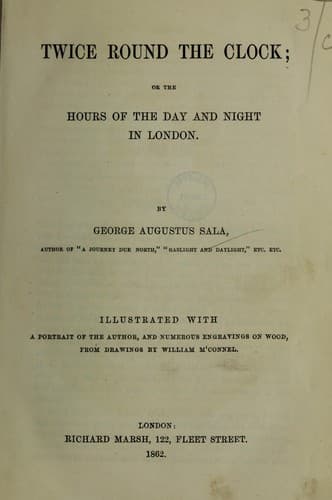
Twice round the clock; or, The hours of the day and night in LondonSala, George Augustus
General
Twice round the clock; or, The hours of the day and night in London
Sala, George Augustus
London (England) -- Social life and customs -- 19th century
The old Saxon Wittenagemotte must have been strongly impregnated with
the club element; and the resemblance of clubs to parliaments has come
down to this day. What, after all, is our much-vaunted British House
of Commons but a club of the first water, somewhat more exclusive than
its brethren of St. James’s, and black-balling its scores of candidates
every general election? It has its reading-rooms, coffee-rooms, and
smoking-rooms; the members lounge in and out, and loll on forms and
benches, just as they would do in Pall Mall; and while some five hundred
members indulge in the real _dolce far niente_ of club life, smoking, and
reading, and dawdling, and dozing, and refreshing themselves, and never
troubling themselves about club matters, save when they are called upon
to vote, the affairs of the club (and of the nation too, by the way)
are managed by a snug little committee, who do all the work and all the
talking, and are continually popping themselves into snug little berths
connected with the management of that other great club which lies beyond
the walls of St. Stephen’s, and is called the Country.
And the middle ages, sunk as the unthinking believe them to have been in
barbarism, had their clubs, and brave ones too. Thorough clubmen were the
old Freemasons; secret and sturdy, and swift in action; and it’s O! to
see the club-houses they erected in the fanes that are yet the pride and
glory of our cathedral towns. When you look at their crenelated towers,
and at the strange sculptures in the rich spandrils of their arches, in
their groins and corbels, in their buttresses and great rose windows,
and cunningly-traced roodscreens and carved bench-ends, you shall find
copious store of club-marks, and secret signs, and passes only known to
themselves, and, grotesque and frivolous as to the uninitiated they seem,
truly drawn from the innermost arcana of the great mystery of masonry.
The old Vehmgericht, too, with its grim symbols, and warnings of the cord
and dagger—may not that be considered as a club? The Flagellants and
the Rosicrucians, were not those queer sects clubs? and what were the
Council of Trent, and the Diet of Worms, but select clubs, frequented by
ecclesiastical and political “swells?”
I am not about to confound the convivial club—with its one room and its
quaint rules, ancient or modern—with its latest perfection, all Portland
stone and plate-glass, gas chandeliers, and luxurious ottomans. Before,
however, I come to the fashionable club of 1859, I may be permitted, I
hope, to discourse for awhile on the jovial clubs, high, low, and middle
class, which have made this metropolis cosy and picturesque for at least
two centuries.
Public-domain text, read in full here on John Shaqi.
Reviews
Reviews
No reviews yet
Be the first to share your thoughts on this work.
Elsewhere in the archive
Join the Discussion
Join the discussion
Sign in to leave a comment or review.
Sign InorCreate an account