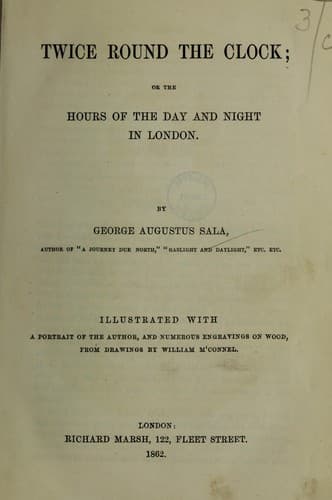
Twice round the clock; or, The hours of the day and night in LondonSala, George Augustus
General
Twice round the clock; or, The hours of the day and night in London
Sala, George Augustus
London (England) -- Social life and customs -- 19th century
There can be little doubt that the Restoration gave a marvellous
incentive to club-life in London. On the one hand, the sour Puritans
and fierce Independents, driven into holes and corners by the advent of
Charles II., had other places of meeting than the conventicles where
they offered their surreptitious worship; and at these stray places of
re-union, they comforted and refected themselves in their own grim,
uncomfortable fashion. On the other hand, the Cavaliers had their riotous
assemblages, where they met to sing “Down among the dead men,” and
drink their king’s health on their knees; the revival of humorous and
theatrical literature filled the taverns and coffee-houses with wits and
dramatists, instead of pedants and theologians; table companions formed
into knots, and knots into throngs, and these at length formed themselves
into clubs, where they could jest and criticise, argue and carouse, at
their ease, without the fear of interlopers; and though, so late as the
days of Foote and Chatterton, a stranger of good address and brilliant
conversation could form a rallying coffee-house acquaintance with the
most famous wits of the town, it was difficult for him to be admitted
into their inner circle; even as, in our own time, a man may find
plenty of conversation in a railway carriage or an hotel coffee-room,
at a German Spa or a charity dinner, but must not feel surprised if
his voluble acquaintance of the previous evening cut him dead the next
time he meets him. The change of succession at the Revolution gave an
impetus both to the establishment and to the exclusiveness of the clubs.
While William, the Dutchman, held his uneasy, hooked-nose pre-eminence
in this country, innumerable were the dim taverns in whose securest
rooms stealthy clubs, with cabalistic names, were held; where, when
the club-room doors were tightly closed, Captain Henchman, late of
Roper’s horse, turned out to be Father Slyboots, high up in the order
of Jesus, where sympathy was openly avowed for Sir John Fenwick, and
the exiles of St. Germains were yet spoken of as the possessors of the
Crown; and where, after William’s death, the health of “the little
gentleman in black velvet,” meaning the molehill over which, according
to the Jacobites, the king’s horse had stumbled, when William fell and
dislocated his collar-bone, was enthusiastically drunk. It would have
been hard, too, if the days of Queen Anne—the Augustan era in which
Swift, Gay, Pope, Addison, Prior, Bolingbroke, Somers, and Dorset, held
their glorious sway of intellect—had not been fruitful in the production
of clubs; and it is to the first quarter of the eighteenth century that
we may trace the birth of our most famous clubs. The accession of George
the First, embittering as it did a new question of the succession to
the throne, gave a fresh lease of popularity to the Jacobite clubs,
which had languished somewhat during the reign of Anne, for sheer want
of something to conspire about.
Public-domain text, read in full here on John Shaqi.
Reviews
Reviews
No reviews yet
Be the first to share your thoughts on this work.
Elsewhere in the archive
Join the Discussion
Join the discussion
Sign in to leave a comment or review.
Sign InorCreate an account