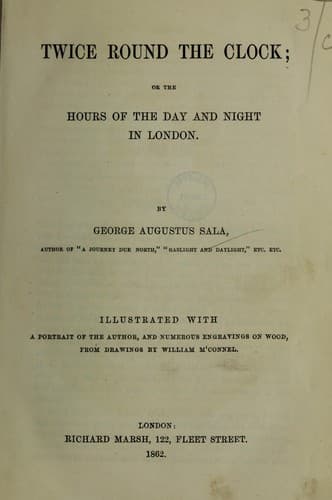
Twice round the clock; or, The hours of the day and night in LondonSala, George Augustus
General
Twice round the clock; or, The hours of the day and night in London
Sala, George Augustus
London (England) -- Social life and customs -- 19th century
with Captain Macheath and Cornet O’Gibbet, and Duvalising travellers,—of
course confining himself to those who were of the Hanoverian way of
thinking. Not the first honest man who has turned highwayman: besides,
was it not for the greater glory of Church and King? When the club had
its next meeting, it might be in ’16 or in ’46 (for the century was quite
gray-headed before the Jacobite clubs quite died out), there would be a
lamentable hiatus here and there in the list of members. Where was Sir
William Flowerdeluce?—Shot at Sheriffmuir. Where Colonel Belmain?—Hanged
at Carlisle. Where young Christopher Layer, the barrister, gallant,
devoted, enthusiastic?—His head was rotting on a spike, over Temple Bar,
within sight of his old chambers. Where Jemmy Dawson, the pride, the pet,
the pearl of the Jacobites, the dashing swordsman of Townley’s ill-fated
Manchester Regiment?—Go ask the judge and jury, go ask the hangman, go
ask the veiled lady in the black coach, who follows the fatal hurdle to
Kennington Common, and sits out the hideous drama, and when she sees
the heart of him she loves cast into the flames, and his fair limbs
dismembered by the executioner, swoons and dies.
I have been reading a little old book, bearing the date of 1725, which
professes to give a “Complete Account” of the principal clubs of
London and Westminster. Its authorship is anonymous; yet I think I can
discern traces of a certain fine Roman hand, well-known to me, in its
composition, and I don’t think I am in error in ascribing it to Mr. Ned
Ward, the scurrilous though amusing author of the “London Spy.” Its
contents must be taken, of course, _cum grano salis_, with the other
lucubrations of that diverting vagabond; yet I am ready to believe
that many of his clubs were then existent. Some of them, indeed, have
come down to our own times. According to the writer of the “Complete
Account,” there was the “Virtuous Club,” established as a succursal to
the Royal Society (which, indeed, was little more than a club at its
commencement), at the Golden Fleece, a tavern in Cornhill, whence they
moved to the Three Tuns, in Southwark: a queer locality, indeed, for
the white-neckclothed savants, who now have their habitat in Burlington
House. The chronicler treats them somewhat contemptuously, as collectors
of “pickled maggots and mummies’ toenails,” and seems considerably
to prefer the “Surly Club,” held at some out-of-the-way place near
Billingsgate Dock, whose members had “a stoker to attend their fire”—I
did not know the appellation “stoker” was so old—a skinker to ignify
their pipes, and a chalk accountant to keep a trencher register of the
club reckoning, lest the landlord below should be tempted to augment
the scot by means of a double-notched chalk. The principal feature
of the “Surly Club” appeared to lie in the members being all surly,
ill-tempered, wrangling chuffs, who were bound to abuse each other and
the world generally, at their every time of meeting. I believe that
Public-domain text, read in full here on John Shaqi.
Reviews
Reviews
No reviews yet
Be the first to share your thoughts on this work.
Elsewhere in the archive
Join the Discussion
Join the discussion
Sign in to leave a comment or review.
Sign InorCreate an account