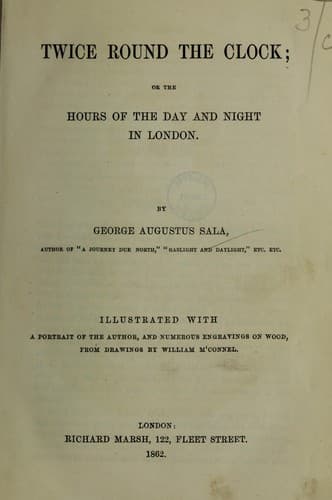
Twice round the clock; or, The hours of the day and night in LondonSala, George Augustus
General
Twice round the clock; or, The hours of the day and night in London
Sala, George Augustus
London (England) -- Social life and customs -- 19th century
there are London clubs, not yet extinct, which carry out the principles
of the “Surly Club” in a remarkably undeviating manner. Then there
was the “Split-Farthing Club,” instituted by a society of usurers and
money-spinners, who met together in the dark, in order to avoid the
expense of candle or lamp-light, and of which the Hopkins immortalised by
Pope was a distinguished member. The “Ugly Club” (which yet flourishes,
I believe,) owed its foundation to a superlatively ugly fellow by the
name of Hatchet (whence the term “hatchet-faced”), who had a nose of
such immense size, that he was one day in the street charged by a
butcher-boy with overturning a tray full of meat, when his head was at
least a foot distant therefrom. A violent attempt was made to break up
the “Ugly Club” by a committee of spinsters, who made unheard-of attempts
to marry the members _en masse_, but in vain. Jack Wilkes was elected
perpetual president of the “Ugly Club,” early in the reign of George
III., and Honorè Gabriel Riquetti, Count de Mirabeau, who had some slight
connection with the first French Revolution, was unanimously chosen an
honorary member on his visit to England. I must not forget to mention
the “Unfortunate Club,” held at the sign of the “Tumbledown Dick,” in
the Mint. To have been at least once bankrupt (a fraudulent failure was
preferred), or to have come in some way in collision with the laws of
the country, was a _sine quâ non_ in the qualification for a member of
the “Unfortunates.” The Market Women’s, or “Flat-cap Club,” was at one
time quite a fashionable place of meeting, being frequented by many of
the wild gallants from the Rose, and Tom King’s coffee-house, who treated
the lady company to burnt brandy and flowing “Winchesters” (_i. e._,
Winchester measures) of “powerful three thread”—our modern porter. Then
there was the “Lying Club,” among whose voluminous rules were these,
that the chairman was to wear a blue cap and a red feather, and that if
any member, in the course of an evening, told a lie more impudent and
egregious than he, the chairman, could manage to cap, he was at once
to vacate the chair in favour of the superior Mendax. There was a very
stringent rule, inflicting a severe fine upon any member who should
presume, between the hours of nine and eleven of the clock, to tell one
word of truth, unless, indeed, he prefaced it with the rider of “By your
leave, Sir Harry”—Sir Harry Gulliver being the name of the original
chairman of the club. There was the “No-Nose Club,” the “Beggars’ Club,”
the “Thieves’ Club,” and the “Northern or Yorkshire Tyke’s Club;” and, to
sum up, there was a horrific assembly, founded in the reign of Charles
II., and called the “Man-killing Club.” The members of this savage
corporation were debased Life-guardsmen, broken-down bullies, and old
scarified prize-fighters. The prime qualification for membership was the
commission of homicide. The “Mohocks,” “Scourers,” and “Sweaters” of
Public-domain text, read in full here on John Shaqi.
Reviews
Reviews
No reviews yet
Be the first to share your thoughts on this work.
Elsewhere in the archive
Join the Discussion
Join the discussion
Sign in to leave a comment or review.
Sign InorCreate an account