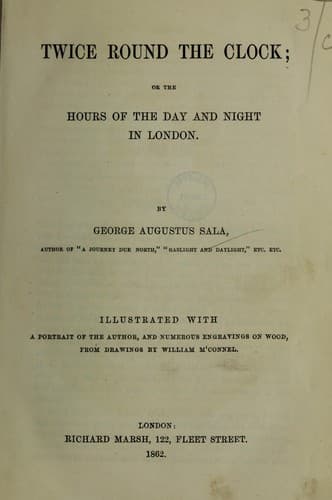
Twice round the clock; or, The hours of the day and night in LondonSala, George Augustus
General
Twice round the clock; or, The hours of the day and night in London
Sala, George Augustus
London (England) -- Social life and customs -- 19th century
Queen Anne’s time, were, as may readily be imagined, highly prominent
members of this murderous fraternity, which might have flourished much
longer but for the interference of the Sheriff’s hangman in ordinary, who
disposed of the members with such amazing despatch and persistence, that
the club could not at last form a quorum, and was so dissolved.
The “Irish Fortune-hunters’ Club” I am somewhat chary of recognising, for
I am afraid that it existed only in the lively fancy of Mr. Ned Ward or
his imitator. There is, indeed, a copy of some resolutions of the club
appended to the “Complete Account,” but I am inclined to consider them
apocryphal. Leave, by these resolutions, is given to Captain Donahoo to
change his name to Talbot Howard Somerset; Captain Macgarret is empowered
to change the place of his nativity from Connemara to Cornwall; and
Lieutenant Dunshunner is presented with a suit of laced camlet at the
club expense, in order to his successfully prosecuting his suit with
Miss Bridget Tallboys, “with ten thousand pounds fortune; in the event
of which happy consummation, he is to repay the price of the suit with
interest, and moreover to release from his captivity at the Gate-house
the club secretary, therein confined on suspicion of debt.”
Very different is the bran-new modern club whose interior my faithful
artist has depicted, and whose appearance at five o’clock in the
afternoon I am now called upon to describe. Gentlemen members of clubs,
these gorgeous palaces are but the growth of one generation. Your
fathers had, it is true, their Wattier’s, the Cocoa-Tree, White’s, and
Boodle’s, but those were considerably more like gambling-houses than
clubs. To obtain admission was exceedingly difficult, and to remain a
member was, save to men of immense fortune, absolutely ruinous. Hundreds
of the superior middle-classes, nay, even of the aristocracy, who would
consider themselves social Pariahs now-a-days, if they did not belong to
one or more clubs, were perfectly content, a score of years since, to
frequent the coffee-rooms of hotels and taverns. A modern London club
is the very looking-glass of the time; of the gay, glittering, polished,
improved utilitarian, material age. Nothing more can be done for a
palace than the fitters-up of a modern club have done for it. The march
of upholstering intellect is there in its entirety. It must be almost
bewildering to the modest half-pay captain or the raw young ensign, to
the country gentleman, the book-worm fellow of his college, or the son of
the country squire, fresh from dog-breaking and superintending the drains
on his father’s estate, to find themselves suddenly transferred from
the quiet lodgings in St. Alban’s Place, the whitewashed barrack-room,
the ivy-grown parsonage, the tranquil oak-sporting rooms of “Keys” or
“Maudlin,” the dull comfort of the country mansion-house, to this great
hectoring palace, of which he is the twelve-hundreth part proprietor,
Public-domain text, read in full here on John Shaqi.
Reviews
Reviews
No reviews yet
Be the first to share your thoughts on this work.
Elsewhere in the archive
Join the Discussion
Join the discussion
Sign in to leave a comment or review.
Sign InorCreate an account