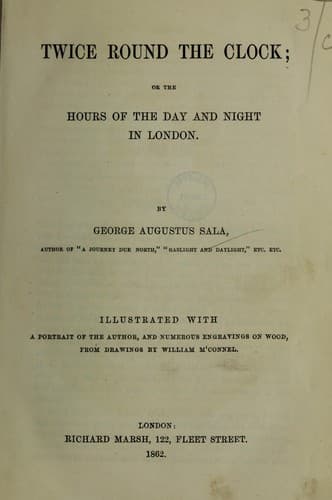
Twice round the clock; or, The hours of the day and night in LondonSala, George Augustus
General
Twice round the clock; or, The hours of the day and night in London
Sala, George Augustus
London (England) -- Social life and customs -- 19th century
About five p.m. the ladies and gentlemen who, through the arbitration
of Mr. Hall, Mr. Jardine, or Mr. Henry, stipendiary magistrates, have
settled their little differences with Justice, are conveyed to those
suburban residences, in which, for the benefit of their health, and in
the interests of society, it is judged necessary, _par qui de droit_,
they shall for a stated term abide. The vehicle which bears them to
their temporary seclusion enjoys different names; some technical,
others simply humorous. By some it is called “Her Majesty’s Carriage,”
from the fact that the crown and the initials “V. R.” are painted on the
panels. More far-fetched wags call it “Long Tom’s Coffin.” The police
and the reporters, for shortness, call it “The Van.” In this vehicle the
malefactors who have in the course of the day been arraigned before the
tribunal of the Bow Street Police-court, are conveyed to the various
jails and houses of correction in and about the metropolis, there to
undergo the several terms of imprisonment and hard labour, as the case
may be, to which they have been sentenced. Sometimes the court sits late,
and the van does not take its departure before half-past five; but five
is the ordinary time when the great black, shining, cellular omnibus,
drawn by two strong horses, with its policeman driver, and policeman
conductor in a snug little watch-box, rolls away from Bow Street. It
is a prison on wheels, a peripatetic penitentiary, a locomotive hulk.
Criminals both in and out of prison regard it with a species of terror,
not unmixed with admiration, and, as is their wont, they have celebrated
it in that peculiar strain of ballad poetry for which London roguery has
been so long distinguished. In that celebrated collection of dishonest
epics, the “Drury Lane Garland,” in fit companionship with “Sam Hall,”
“County Jail,” “Seven years I got for priggin’,” and the “Leary Man,” I
find a ballad on the subject of the Bow Street chariot of disgrace, of
which the refrain is—
“Sing Wentilator, separate cell,
Its long, and dark, and hot as well.
Sing locked-up doors—git out if you can,
_There’s a crusher outside the prisoners’ wan!_”
A “crusher,” or policeman, there is indeed, not only in the little
watch-box on the exterior, to which I have alluded, but in the narrow
corridor between the cells into which the carriage is divided in the
interior. It is the former functionary’s duty to keep the outer door
securely locked; the latter to take care that no communication takes
place between the passengers confined in this penal omnibus, either
through the ventilators on the roof, or by talismanic tappings at the
panels which divide them.
[Illustration: FIVE O’CLOCK P.M.: THE PRISONERS’ VAN.]
Public-domain text, read in full here on John Shaqi.
Reviews
Reviews
No reviews yet
Be the first to share your thoughts on this work.
Elsewhere in the archive
Join the Discussion
Join the discussion
Sign in to leave a comment or review.
Sign InorCreate an account