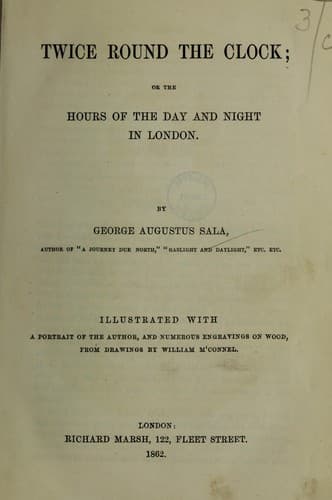
Twice round the clock; or, The hours of the day and night in LondonSala, George Augustus
General
Twice round the clock; or, The hours of the day and night in London
Sala, George Augustus
London (England) -- Social life and customs -- 19th century
When the hour of departure arrives, you see the pavement and carriage-way
of Bow Street studded with a choice assemblage of the raggedry,
ruffianry, felonry, misery, drunkardry, and drabbery, whom the infamous
hundred of Drury, and the scarcely less infamous tithing of Covent, have
cast out into a thoroughfare which, two hours hence, will be re-echoing
to the wheels of carriages bearing noble lords and ladies to listen to
the delicious Bosio (alas!) in the “Traviata,” or the enchanting notes
of Tamberlik in “Otello.” London is full of violent contrasts; but this
is the grimmest in the whole strange catalogue. See, the warder in the
watch-box has descended from his perch, and with a patent key opened
the portal of the van, revealing a second janitor inside. And now the
passengers destined for the lugubrious journey come tumbling out of
the court door, and down the steps towards the van. Some handcuffed,
some with their arms folded, or their hands thrust in their pockets in
sullen defiance; some hiding their faces in their grimy palms for very
shame. There are women as well as men, starved sempstresses, and brazen
courtezans in tawdry finery. There are wicked graybeards, and children
on whose angel faces the devil has already set his indelible brand.
There are ragged losels rejoicing to go to jail as to a place where
they shall at least have bread to eat and a bed to lie on; there are
dashing pickpockets in shiny hats and pegtop trousers braided down the
seams. There are some going to prison for the first, and some for the
fiftieth time. One by one they are thrust rather than handed into the
van. The shabby crowd gives a faint, derisive cheer, the door bangs,
the policeman-conductor ensconces himself in his watch-box, and the
Prisoners’ Van drives off.
The Pharisee thanked Heaven that he was not “as that Publican.” Down
on your knees, well-nurtured, well-instructed youth, and thank Heaven
for the parents and friends, for the pastors and masters, to whose
unremitting care and tenderness, from your cradle upwards, you owe it
that you are not like one of these miserable Publicans just gone away
in the prisoners’ van. But thank Heaven humbly, not pharisaically. A
change at nurse, the death of a parent—one out of the fifty thousand
accidents that beset life—might have thrown you into the sink of misery
and want, foulness and crime, in which these creatures were reared,
and you might have been here to-day, not gazing on the spectacle with
a complacent pity, but trundled with manacles on your wrists into this
moving pest-house, whose half-way house is the jail, and whose bourne is
the gallows.
SIX P.M.—A CHARITY DINNER, AND THE NEWSPAPER WINDOW AT THE GENERAL
POST-OFFICE.
Public-domain text, read in full here on John Shaqi.
Reviews
Reviews
No reviews yet
Be the first to share your thoughts on this work.
Elsewhere in the archive
Join the Discussion
Join the discussion
Sign in to leave a comment or review.
Sign InorCreate an account