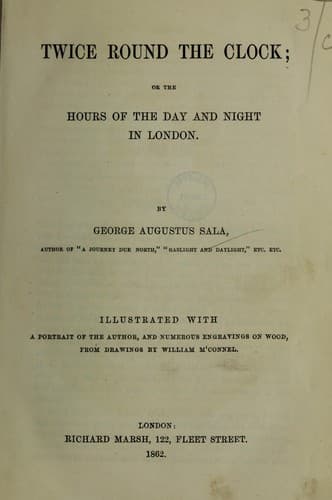
Twice round the clock; or, The hours of the day and night in LondonSala, George Augustus
General
Twice round the clock; or, The hours of the day and night in London
Sala, George Augustus
London (England) -- Social life and customs -- 19th century
Some years ago, at the cozy little dining club held in my friend
Madame Basque’s back-parlour, in the Rue de la Michodière, and the
city of Paris, I had the advantage of the friendship of one of the
most intelligent and humorous of the American gentlemen. There is
such a personage—the vulgar, drawling, swearing, black-satin-vested,
stove-pipe-hatted, whittling, smoking, expectorating, and dram-drinking
Yankee loafers, who infest the Continent, notwithstanding; and a very
excellent sample of the accomplished and unpretending gentleman was the
American in question. He had paid a visit to England, in which country
his sojourn had been of about three months’ duration; but he frankly
confessed to me that having come purposely unprovided with those usually
tiresome and worthless figments, letters of introduction—the very
Dead-Sea apples of hospitality, goodly on the exterior, and all dust and
ashes within—he had not, with the exception of his banker, who asked him
to dinner once as a courteous acknowledgment of the ponderosity of his
letter of credit, possessed one single acquaintance, male or female,
during his stay in the metropolis of the world. I asked him whether he
had not felt very lonely and miserable, and sufficiently inclined, at
the end of the first week, to cast himself over any given bridge into
the river Thames. Not in the slightest degree, he replied. I politely
hinted that perhaps, as an American, he possessed the genial facility,
common to his countrymen, of making himself at home wheresoever he
went, and of forming agreeable travelling acquaintances, occasionally
ripening into fast friends, by the simple process of saying “Fine day,
stranger.” Not at all, he replied. He kept himself to himself, and
indeed he was of a disposition, save in casual moments of unbending,
quite surprising for its saturnine taciturnity. At all events, I urged,
he could not have amused himself much by prowling about the streets,
sleeping at hotels, dining in coffee-rooms, frequenting theatres and
singing-rooms, and wandering in and out of museums; but I was wrong
again, he said. He had seldom been so jolly in his life. I began to think
either that he was quizzing me—“gumming” is the proper Transatlantic
colloquialism, I think—or else that he was the Happy Man described in
the Eastern apologue. But then, the Happy Man had, as it turned out,
no shirt; and my American was remarkable for displaying a vast amount
of fine linen, both at breast and wristbands, profusely decorated with
studs, chains, and sleeve-buttons. How was it, then, I asked, giving the
enigma up in sheer bewilderment. “Wall,” answered my friend with his own
peculiar dry chuckle, “I used to ride about all day on the tops of the
omnibuses; and very fine institutions for seeing life in a philosophical
spirit, those omnibuses of yours are, sir.” He said Sir—not “Sirree,”
as Anglo-Americans are ordinarily assumed to pronounce that title of
courtesy.
Public-domain text, read in full here on John Shaqi.
Reviews
Reviews
No reviews yet
Be the first to share your thoughts on this work.
Elsewhere in the archive
Join the Discussion
Join the discussion
Sign in to leave a comment or review.
Sign InorCreate an account