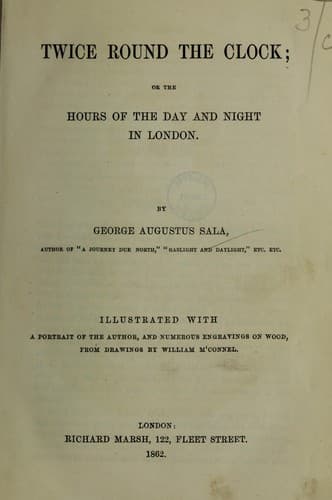
Twice round the clock; or, The hours of the day and night in LondonSala, George Augustus
General
Twice round the clock; or, The hours of the day and night in London
Sala, George Augustus
London (England) -- Social life and customs -- 19th century
In genteel society, the half hour before dinner is generally accepted
as a time of unlimited boredom and social frigidity, but there you have
the relief, if not relaxation, of staring the guests out of countenance,
making out a mental list of the people you would not like to take wine
with, and turning over the leaves of the melancholy old albums, every
page of which you have conned a hundred times before. But in the half
hour (and it frequently is a whole one) before a public dinner, you have
no albums or scrapbooks to dog’s-ear. There is no use in staring at your
neighbours: the types of character are so similar—big and crimsoned
sensuous faces looming over white waistcoats, with a plentiful sprinkling
among them of the clerical element. You can’t smoke, you can’t (that is,
I daren’t) order sherry and bitters. If you look out of the window, you
see nothing but chimney pots, leads, and skylights, with a stray vagrant
cat outrunning the constable over them; and the best thing you can do is
to bring an amusing duodecimo with you, or betake yourself to one of the
settles, and twiddle your thumbs till dinner-time. But, joy, joy, here
are quails in the conversational famine; here is a welling spring in the
wilderness. The door opens, and the sonorous voice of the head-waiter
announces THE CHAIRMAN.
Very probably he is a lord. A philanthropic peer, always ready and
willing to do a kind turn for anybody, and to the fore with his
chairmanship, his set speeches, and his fifty-pound note for “fatuous
monomaniacs,” “intellectual good-for-nothings,” or “decayed bailiffs.” He
may be a regular dining-out lord, a not very rich nobleman, who has grown
gray in taking the chair at charity dinners, and who is not expected
to give anything to the institution save the powerful weight of his
presence and influence. He may be a young lord, fresh caught, generously
eager (as are, I am rejoiced to say, the majority of our young lords
now-a-days) to vindicate the power and willingness for usefulness of his
order; striving to show that there is not so much difference between
his coronet and the Phrygian cap, save that one is made of velvet and
the other of red worsted (ah! that irreconcileable red worsted), very
impulsive, very imprudent, sometimes slightly imbecile, but full of good
intentions and honest aspirations; or he may be a member of Parliament,
a veteran of the back benches, burning to make up for his silence in
the House by his eloquence in the forum of a tavern dinner. He may be
a worthy banker or merchant, who gets through the speech-making before
him in a business-like manner, and does not allow it in the least to
interfere with the consumption of his proper quantum of wine; or he may
be, as is very frequently the case, a lion—the “great gun”—the last blast
of Fame’s trumpet for the hour: a lawyer, a traveller, a philosopher, or
an author, whom the managing committee have secured, just as the manager
Public-domain text, read in full here on John Shaqi.
Reviews
Reviews
No reviews yet
Be the first to share your thoughts on this work.
Elsewhere in the archive
Join the Discussion
Join the discussion
Sign in to leave a comment or review.
Sign InorCreate an account