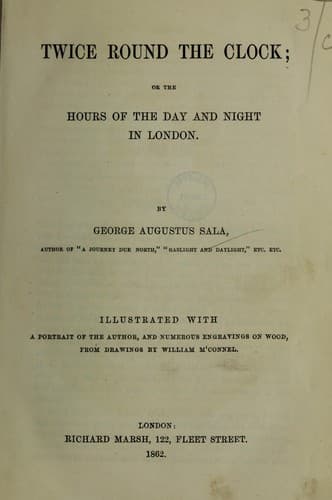
Twice round the clock; or, The hours of the day and night in LondonSala, George Augustus
General
Twice round the clock; or, The hours of the day and night in London
Sala, George Augustus
London (England) -- Social life and customs -- 19th century
of a theatre would secure a dwarf, a giant, a wild beast tamer, a blind
piper, or a sword swallower, to enhance the receipts of the exhibition.
About thirty of the fifty people I don’t know from Adam gather
immediately in a circle round the chairman. The few who have the honour
to be on speaking terms with him jostle him sociably, and shake hands
with him with a rueful expression of contentment. Those who don’t know
him rub their hands violently, breathe hard, stare fixedly at him,
and whisper to one another that he is very like his portrait, or that
he isn’t at all like his portrait, or that he is getting old, or that
he looks remarkably young, or some equally relevant banalities. The
remaining twenty guests gather in the window-bays, and stare at nothing
particular, or else read the printed prospectus of the Asylum for Fatuous
Monomaniacs, and wonder how many of the fine list of stewards announced
may be present on the occasion. As for the chairman, he takes up a
position with his back safely glued (so it seems) to the mantelpiece, and
preserves a dignified equanimity, working his head from side to side in
his white neckcloth like that waxen effigy of Mr. Cobbett, late M.P. for
Oldham, which terrifies country cousins by its vitality of appearance
(those drab smallclothes and gaiters were a great stroke of genius) at
Madame Tussaud’s.
By this time a crowd of more people you don’t know from Adam, and
often outnumbering the fifty in the waiting-room, have gathered on the
staircase, the landing, and have even invaded the precincts of the dining
saloon, where they potter about the tables, peeping for the napkins
which may contain the special cards bearing their name and denoting their
place at the banquet. These are the people who _do_ know one another;
these are the stewards, patrons of the charity, or gentlemen connected
with its administration. They are all in a very excellent temper, as men
need be who are about to partake of a capital dinner and a skinful of
wine, and they crack those special jokes, and tell those special funny
stories, which you hear nowhere save at a public dinner. Then, at the
door, you see a detachment of waiters, bearing fasces of long, blue
staves, tipped with brass, which they distribute to sundry inoffensive
gentlemen, whose real attributes are at once discovered, and who are
patent to the dining-out world as Stewards. They take the staves, looking
very much ashamed of them; and, bearing besides a quaint resemblance to
undertakers out for a holiday, and in a procession, which would be solemn
if it wasn’t funny, precede the chairman to his place of honour.
Public-domain text, read in full here on John Shaqi.
Reviews
Reviews
No reviews yet
Be the first to share your thoughts on this work.
Elsewhere in the archive
Join the Discussion
Join the discussion
Sign in to leave a comment or review.
Sign InorCreate an account