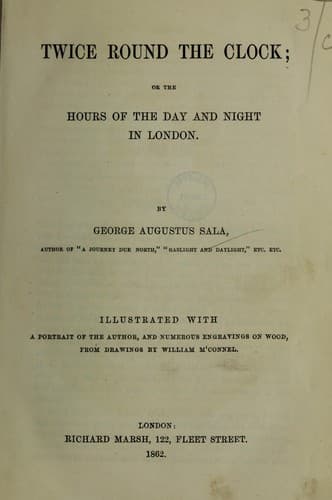
Twice round the clock; or, The hours of the day and night in LondonSala, George Augustus
General
Twice round the clock; or, The hours of the day and night in London
Sala, George Augustus
London (England) -- Social life and customs -- 19th century
I do not think I am called upon to give the bill of fare of a public
dinner. I have no desire to edit the next republication of Ude, or
Doctor Kitchener, Soyer, or Francatelli; besides, I could only make your
and my mouth water by expatiating on the rich viands and wines which
“mine host” (he is always mine host) of the Albion, the London Tavern,
or the Freemasons’, provides for a guinea a-head. You remember what I
told you the friend with the face like an over-ripe fig said of public
dinners—that they were the sublimation of superfluities; and, indeed, if
such a repast be not one of those in which a man is called upon to eat
Italian trout, Dutch dory, Glo’ster salmon, quails and madeira, Cherbourg
pea-chicks, Russian artichokes, Macedonian jellies, Charlottes of a
thousand fruits, Richelieu puddings, vanilla creams, Toulouse leverets,
iced punch, hock, champagne, claret, moselle and burgundy, port, sherry,
kirschwasser, and pale brandy, I don’t know the meaning of the word
superfluity at all.
Some three hours after the company have sate down to dinner; after
the “usual loyal and constitutional toasts,” with the usual musical
honours; after the toast of the evening—“Prosperity to the Royal Asylum
for Fatuous Monomaniacs”—with its accompanying (more or less) eloquent
speech from the noble or distinguished chairman, beseeching liberal
pecuniary support for so deserving an institution; after the prompt and
generous response, in the way of cheques and guineas, from the guests;
after a tedious programme of glees and ballads has been got through,
and the chairman has discreetly vanished to his carriage; after the
inveterate diners-out, who _will_ tarry long at the wine, have received
one or two gentle hints that coffee awaits their acceptance in an
adjoining apartment; and about the time that the feast begins to wear
a somewhat bleared and faded aspect (the lights cannot grow pale till
they are turned off, for these are of the Gas Company’s providing), the
waiters slouch about with wooden trays, full of ruined dessert-plates,
cracked nuts, muddy decanters, and half-emptied glasses; cherry stalks,
strawberry stems, squeezed oranges, the expressed skins of grapes, litter
the tables; chairs are standing at all sorts of eccentric angles; and
crumpled and twisted napkins are thrown pell-mell about. There is an
end to the fine feast: the cates are eaten, the wine drunk. Lazarus the
beggar might have taken his rags out of pawn (had he indeed any such rags
to mortgage), and his thin-limbed little brats might have grown plump and
rosy on a tithe of the money that has been wasted this night in guttling
and guzzling. Wasted? Oh! say not wasted, Cynic; take the mote from thine
own eye. Grumbler, for shame! I have done ill, I think, to caricature
the name even of any public charity. Let the “Fatuous Monomaniacs” be
numbered with the rest of my exploded fantastic conceits. Let this rather
be remembered: that the tavern feast of superfluities is prolific in
Public-domain text, read in full here on John Shaqi.
Reviews
Reviews
No reviews yet
Be the first to share your thoughts on this work.
Elsewhere in the archive
Join the Discussion
Join the discussion
Sign in to leave a comment or review.
Sign InorCreate an account