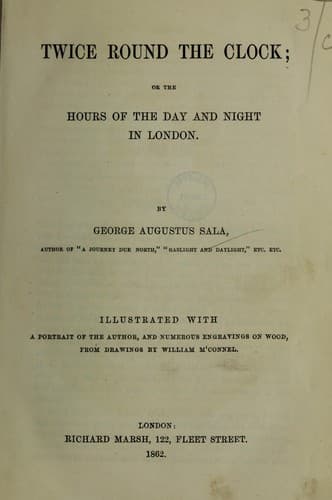
Twice round the clock; or, The hours of the day and night in LondonSala, George Augustus
General
Twice round the clock; or, The hours of the day and night in London
Sala, George Augustus
London (England) -- Social life and customs -- 19th century
regions where dwell the theatrical tailor and tailoress—I entreat them to
excuse me, the _costumier_ and the mistress of the robes—with whom they
confer on the weighty subject of the dresses which they are to wear that
evening. The carpenters abandon work; the scene-shifters, whose generic
name in technical theatrical parlance is “labourers,” moon about the back
part of the stage, seeing that the stock of scenery for the evening is
all provided, the grooves duly blackleaded and the traps greased, and all
the “sinks” and “flies,” ropes and pulleys, and other theatrical gear
and tackle, in due working order. For, you see, if these little matters
be not rigidly and minutely attended to, if a rope be out of its place
or a screw not rightly home, such trifling accidents as mutilation and
loss of life are not unlikely to happen. That the occurrence of such
casualties is of so extreme a rarity may be ascribed, I think, to the
microscopic care and attention which these maligned theatrical people
bestow on every inch of their domain behind the scenes. They have to
work in semi-darkness, and under many other circumstances of equal
disadvantage; but, next to a fire-engine station and the ’tween decks
of a man-o’-war, I do not think that I can call to mind a more orderly,
better-disciplined, better-tended place than that part of a theatre which
lies behind the foot-lights.
Now, mouse-like, from undiscovered holes, patter softly mysterious
females in tumbled mob-caps and battered bonnets, who, by the way, have
been pottering stealthily with brooms and brushes about the pit and boxes
in the morning, disappearing towards noon. They proceed to disencumber
the front of the house of the winding-sheets of brown holland in which it
has been swathed since last midnight. These are the “cleaners,” and when
they have made the house-clean and tidy for the audience of the evening,
dusted the fauteuils, and swept the lobbies, they hie them behind the
scenes, see that the proper provision of soap and towels exists in the
dressing-rooms, perhaps lend a hand to the scene-shifters, who are
completing _their_ afternoon’s labour by scientifically irrigating the
stage with watering-pots; or, if a tragedy is to be performed, spreading
the green baize extending to the foot-lights—that incomprehensible
green baize—that field _vert_ on which Paris dies combatant, and Hamlet
lies rampant, and without whose presence it is considered by many
dramatic sages no tragedy could possibly be enacted.[8] Meanwhile, the
property-man has brought to the verge of the wings, or laid out in trays
and hampers, ready to be conveyed below by his assistants, the necessary
paraphernalia and appurtenances for the pieces in that night’s bill.
Shylock’s knife and scales, Ophelia’s coffin, Claude Melnott’s easel
and maulstick, Long Tom Coffin’s mob-cap; the sham money, sham words,
sham eatables and drinkables of this unreal and fantastic world, are
all prepared.
Public-domain text, read in full here on John Shaqi.
Reviews
Reviews
No reviews yet
Be the first to share your thoughts on this work.
Elsewhere in the archive
Join the Discussion
Join the discussion
Sign in to leave a comment or review.
Sign InorCreate an account