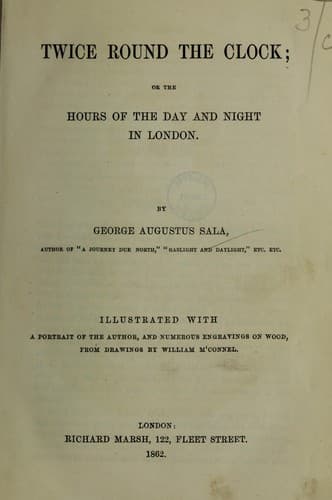
Twice round the clock; or, The hours of the day and night in LondonSala, George Augustus
General
Twice round the clock; or, The hours of the day and night in London
Sala, George Augustus
London (England) -- Social life and customs -- 19th century
processes, positively wanted to see the Eleusinian mysteries of the
interior of a London theatre. I showed them to him, and he is grateful
still. I meet him occasionally at places of public resort. He is next
to senior partner now, but he never hints at six-and-eightpence when I
ask a legal question; and his most valuable act of friendship is this,
that whenever the Sheriff of Middlesex is moved to run up and down in
his bailiwick, with a special reference to my disparagement, I receive
a mysterious message, generally conveyed by a battered individual, who
wipes his face on the sleeve of his coat, and is not averse to taking
“something short,” that there is “something out” against me, and that I
had better look sharp. Whereupon I look out as sharp as I can for the
most convenient tenth milestone out of Babylon.
Now, friend and fellow-traveller of mine, do you mind transforming
yourself for the nonce into the friendly solicitor, and coming with me
“behind the scenes?” I know that with these continual metamorphoses I
am making a very golden ass of Apuleius of you; but it is all, believe
me, for your benefit. I don’t want you to stand a dinner at Verrey’s. I
only want you to put on the slippers of patience and the spectacles of
observation, and to follow me.
There is, the moralist hath said, a time for all things, and that much
libelled institution, a theatre, has among its Bohemian faults of
recklessness and improvidence, the somewhat rare virtue of punctuality.
Even those events of its daily life which depend for the extent of
their duration upon adventitious circumstances, are marked by a
remarkably well-kept average. Theatrical rehearsals generally commence
at ten o’clock in the morning; and though it will sometimes happen, in
the case of new pieces about to be produced—especially pantomimes and
_spectacles_, that the rehearsal is prolonged to within a few minutes of
the rising of the curtain for the evening performance, the usual turning
of an ordinary rehearsal’s, or series of rehearsals’ lane, is four
o’clock p.m. Then the _répétitêur_ in the orchestra shuts up his fiddle
in its case, and goes home to his tea. Then the young ladies of the
_corps de ballet_, who have been indulging in saltatory movements for the
last few hours, lay aside their “practising dresses”—generally frocks of
ordinary material, cut short in the manner immortalised by that notable
pedlar, Mr. Stout, in his felonious transaction with the little old woman
who fell asleep by the king’s highway—and subside into the long-flounced
garments of common life, which are to be again replaced so soon as
seven o’clock comes, by the abridged muslin skirts and flesh-coloured
continuations of ballet-girlhood. The principal actresses and actors
betake themselves to dinner, or to a walk in the park, or give themselves
a finishing touch of study in the parts they are not yet quite perfect
in, or, it may be, mount the steep theatrical stairs to the mountainous
Public-domain text, read in full here on John Shaqi.
Reviews
Reviews
No reviews yet
Be the first to share your thoughts on this work.
Elsewhere in the archive
Join the Discussion
Join the discussion
Sign in to leave a comment or review.
Sign InorCreate an account