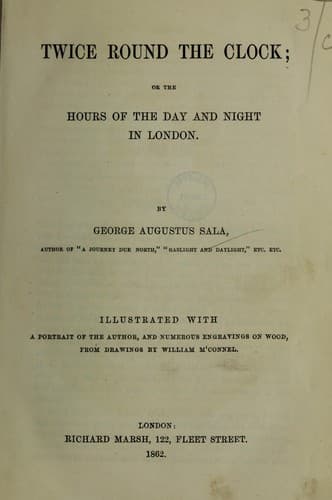
Twice round the clock; or, The hours of the day and night in LondonSala, George Augustus
General
Twice round the clock; or, The hours of the day and night in London
Sala, George Augustus
London (England) -- Social life and customs -- 19th century
Only two functionaries are ever watchful, and do not entertain the
slightest thought, either of suspending their vigilance, or of leaving
the theatre. At the entrance, in his crabbed little watch-box by the
stage-door, the grim man in the fur cap, who acts as Cerberus to
the establishment, sits among keys and letters for delivery. Of a
multifarious nature is the correspondence at a stage-door. There are
County Court summonses, seductive offers from rival managers to the
popular tragedian of the day, pressing entreaties for orders, pink
three-cornered notes scented and sealed with crests for the _première
danseuse_, frequently accompanied by pinned-up _cornets_ of tissue-paper
containing choice bouquets from Covent Garden. There are five-act
tragedies, and farces, written on official paper for the manager;
solicitations for engagements, cards, bills, and applications for benefit
tickets. But the grim man at the stage-door takes no heed of them, save
to deliver them to their proper addresses. He takes no heed either
(apparently) of the crowds of people, male and female, who pass and
repass him by night and by day, from Monday till Saturday. But he knows
them all well, be assured; knows them as well as Charon, knows them as
well as Cerberus, knows them as well as the turnkey of the “lock” in a
debtor’s prison. Scene-shifter or popular tragedian, it is all one to
him. He has but to obey his _consigne_ to let no one pass his keyed and
lettered den who is not connected with the theatre, or who has not the
_entrée_ behind the scenes by special managerial permission; and in
adhering to that, he is as inflexible as Death. And while he guards the
portal, Manager Doldrum sits in his easy-chair in his manuscript-littered
private room upstairs. The rehearsal may be over, but still he has work
to do. He has always work to do. Perhaps he anticipates a thin house
to-night, and is busy scribbling orders which his messenger will take
care shall permeate through channels which shall do the house no harm. Or
he may be glancing over a new farce which one of the accredited authors
of the theatre has just sent in, and with black-lead pencil suggesting
excisions, additions, or alterations. Or perhaps he tears his hair and
gnashes his teeth in dignified privacy, thinking with despair upon the
blank receipts of the foregone week, murmuring to himself, “Shall I
close! shall I close?” as a badgered and belated Minister of State might
ask himself, “Shall I resign?”
Public-domain text, read in full here on John Shaqi.
Reviews
Reviews
No reviews yet
Be the first to share your thoughts on this work.
Elsewhere in the archive
Join the Discussion
Join the discussion
Sign in to leave a comment or review.
Sign InorCreate an account