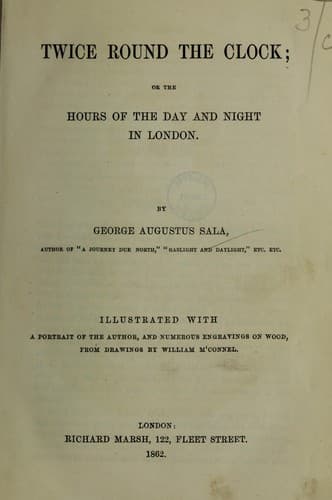
Twice round the clock; or, The hours of the day and night in LondonSala, George Augustus
General
Twice round the clock; or, The hours of the day and night in London
Sala, George Augustus
London (England) -- Social life and customs -- 19th century
I wonder how many people there are who see the manager airing his white
waistcoat in his especial stage-box, or envy him as he drives away from
the theatre in his brougham, or joyfully takes his cheque on Ransom’s
for that last “stunning” and “screaming” new farce that forty pounds
were given for, and that ran four nights; I wonder how many of these
outsiders of the theatrical arcana know what a persecuted, hunted dog,
a genteel galley-slave, a well-dressed Russian serf, is the theatrical
manager. He may well be coarse and _brusque_ in his manners, captious and
pettish in conversation, remiss in answering letters, averse to parting
with ready money for manuscripts which are often never acted, and more
often never read. Do you know the life he leads? Mr. Pope’s existence
at Twickenham (or Twitnam), about the period when he instructed “good
John,” his man, to say that he was sick, or dead, was a combination of
halcyon days compared to the life of a theatrical manager. Are there sons
“destined their fathers’ souls to cross,” who “pen a stanza when they
should engross?” are there men with harum-scarum lunatic projects, with
tomfool notions that they are tragedians, with tragedies and farces, to
estimate whose real value one should make a handsome deduction for the
injury done to the paper on which they are written? are there madcap
young ladies, newly-whipped at boarding-school, who fancy that they have
the vocal powers of Grisi or Bosio, or the tragic acquirements of Ellen
Tree or Helen Faucit (excuse the Kean and Martin marital prefixes: the
old names are _so_ pleasant)? are there mad mothers who vehemently insist
that their skimping daughters can dance like Rosati or Pocchini? are
there “guardians,” in other words the proprietary slaveholders of dwarfs
and contorsionists, precocious pianists, and female violoncellists? are
there schemers, knaves, Yankee speculators, foreign farmers of singers
with cracked voices, bores or insipid idlers—they all besiege the
theatrical manager, supplicate, cajole, annoy, or threaten him. If he
doesn’t at once accede to their exorbitant terms, they forthwith abuse
him scurrilously out of doors. He is a robber, an impostor, a miser, a
Jew. He has been transported. He is insolvent. He came out ten years
since in the provinces, and in light comedy, and failed. He beats his
wife. He was the ruin of Miss Vanderplank, and sent men into the house
to hiss and cry out “pickles” when Toobey the tragedian was performing
his starring engagements, because, forsooth, Toobey did not draw. He owes
ten thousand pounds to Miss Larke, the _soprano_. He buys his wardrobe
in Petticoat Lane. He drinks fearfully. He will be hung. I have been an
editor, and know the amenities that are showered on _those_ slaves of the
lamp; the people who accuse you of having set the Thames on fire, and
murdered Eliza Grimwood, if you won’t accept their interminable romances,
and darkly insinuate that they will have your heart’s blood if you
Public-domain text, read in full here on John Shaqi.
Reviews
Reviews
No reviews yet
Be the first to share your thoughts on this work.
Elsewhere in the archive
Join the Discussion
Join the discussion
Sign in to leave a comment or review.
Sign InorCreate an account