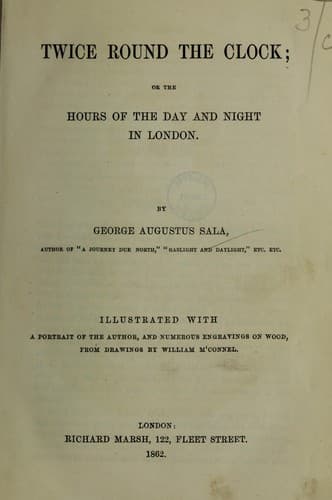
Twice round the clock; or, The hours of the day and night in LondonSala, George Augustus
General
Twice round the clock; or, The hours of the day and night in London
Sala, George Augustus
London (England) -- Social life and customs -- 19th century
decline to pay for poems copied from the annuals of eighteen hundred and
thirty-six; but to find the acme of persecution and badgering commend me
to a theatrical manager.
Return we to our muttons. The theatre sleeps a sound, tranquil sleep for
some hundred minutes; but about six it begins to wake again to fresh
life and activity. At half-past six it is wide awake and staring. The
“dressers,” male and female, have arrived, and are being objurgated by
incensed performers in their several _cabinets de toilette_, because they
are slow in finding Mr. Lamplugh’s bagwig, or Mademoiselle Follejambe’s
white satin shoes. The call-boy—that diminutive, weazened specimen of
humanity, who has never, so it seems, been a boy, and never will be
a man—has entered upon his functions, and already meditates a savage
onslaught on the dressing-room doors, accompanied by a shrill intimation
that the overture is “on.” Let us leave the ladies and gentlemen engaged
in the theatre to complete the bedizenment of their apparel, and, pending
their entrance into the green-room, see what that apartment itself is
made of.
Of course it is on a level with the stage, and within a convenient
distance of that prompt-box which forms the head-quarters of the
call-boy, and where he receives instructions from his adjutant-general,
the prompter. In country theatres, the green-room door is often within
a foot or so from the wing; and there is a facetious story told of
a whilom great tragedian, who, now retired and enjoying lettered
and dignified ease as a country gentleman, was, in his day, somewhat
remarkable for violent ebullitions of temper. He was playing Hamlet; and
in the closet scene with Gertrude, where he kills the old chamberlain,
who lies in ambuscade, and just at the moment he draws his rapier, it
occurred to his heated imagination that an inoffensive light comedian,
ready dressed for the part of Osric, who was standing at the green-room
door within reasonable sword range, was the veritable Polonius himself.
Whereupon the tragedian, shrieking out, “A rat! a rat! dead, for a
ducat—dead!” made a furious lunge at the unhappy Osric, who only escaped
instant death by a timely hop, skip, and jump, and fled with appalling
yells to a sofa, under which he buried himself. Tradition says that the
tragedian’s rapier went right through the wood-work of the half-opened
door; but I know that tradition is not always to be trusted, and I
decline to endorse this particular one now.
Public-domain text, read in full here on John Shaqi.
Reviews
Reviews
No reviews yet
Be the first to share your thoughts on this work.
Elsewhere in the archive
Join the Discussion
Join the discussion
Sign in to leave a comment or review.
Sign InorCreate an account