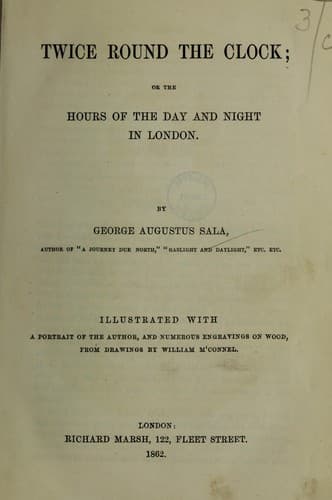
Twice round the clock; or, The hours of the day and night in LondonSala, George Augustus
General
Twice round the clock; or, The hours of the day and night in London
Sala, George Augustus
London (England) -- Social life and customs -- 19th century
There are yet a few green-rooms where the genus “swell” still finds a
rare admittance. See here a couple in full evening costume, talking to
the pretty young lady in the low-necked dress on the settee; but the
swell is quite a fish out of water in the green-room of these latter
days. Managers don’t care quite so much for his patronage, preferring
to place their chief reliance and dependence on the public. The actors
don’t care about him, for the swell is not so generous as of yore in
taking tickets for the benefits of popular favourites. Actresses mistrust
him, for the swell has given up raising actresses to the peerage. The
ballet-girls are half afraid of him; and when they don’t fear him,
they laugh at him. So the swell wanders in and out of the green-room,
and stares at people uneasily, and at last escapes to his brougham or
his cabriolet at the stage-door. Now and then a wicked old lord of the
unrighteous evil-living school of British peers, now happily becoming
rarer and rarer every day, will come sniggering and chuckling into a
green-room, hanging on the arm of the manager, with whom he is on the
most intimate terms, and who “My Lords” him most obsequiously. He rolls
his scandalous old eyes in his disreputable, puckered face, seeking some
pretty, timid, blushing little flower, whom he may blight with his Upas
gaze, and then totters away to his stage-box, where he does duty for the
rest of the evening with a huge double-barrelled opera-glass.
Such is the green-room of to-day, quiet, occasionally chatty (for
actresses and actors can be pleasant enough among themselves, in a
cosy, sensible manner, talking about butcher’s meat, and poor’s-rates,
and Brompton omnibuses); but not by any means the glittering Temple
of Radiant Delight that some might feel inclined to imagine it. There
have been days—and I remember them—when green-rooms were very different
places. There were women on the stage then who were Queens as well as
actresses, and had trains of admirers round their flowing robes. There
was a slight nervous man in those days—a famous writer of plays and books
that yet live, and will live while our English language is spoken—a
strange-looking, high-cheek-boned man, with long hair carelessly thrown
away from his forehead, and a piercing eye, that seemed to laugh to scorn
the _lorgnon_ dangling from its ribbon. I have seen him so, his spare
form leaning against the mantel, and he showering—yes, showering is the
word—arrowy _bon mots_ and corruscating repartees around him. He is
dead: they all seem to be dead, those brilliant green-room men—Jerrold,
Talfourd, Kenney, Haynes Bayley, Hook, A’Beckett. They have left no
successors. The modern play-wrights skulk in and out of the manager’s
room, and are mistaken at rehearsal for the property-men. They forsake
green-rooms at night for drawing-rooms, where they can hear themselves
praised, or smoking-rooms of clubs, where they can abuse one another; and
if A. says a good thing, B.
Public-domain text, read in full here on John Shaqi.
Reviews
Reviews
No reviews yet
Be the first to share your thoughts on this work.
Elsewhere in the archive
Join the Discussion
Join the discussion
Sign in to leave a comment or review.
Sign InorCreate an account