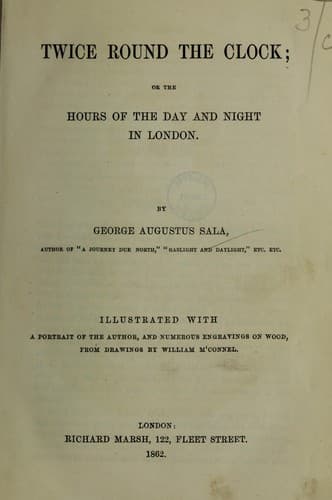
Twice round the clock; or, The hours of the day and night in LondonSala, George Augustus
General
Twice round the clock; or, The hours of the day and night in London
Sala, George Augustus
London (England) -- Social life and customs -- 19th century
books it for his next _petite comédie_, which
does not hurt A. much, seeing that he stole it from C., who translated it
hot-and-hot from Monsieur de D., that great plagiarist from Lope de Vega.
Come, let us leave the green-room to its simple devices, and see what
they are doing “Behind the Scenes.” You and I, we know, are in the
receipt of fern-seed, and can walk invisible without incommoding ourself
or anybody else, be the pressure ever so great; but I should strongly
advise all swells and other intruders, if any such remain, either to
withdraw into the shadiest recesses of the green-room, or to “get out of
that”—to use an Irishism, without the least possible delay. For “Behind
the Scenes” is clearly no place for them. If I were the manager of a
theatre, I would not admit one single person into the _coulisses_ save
those connected with the night’s performance, nay, nor allow even the
_employés_ of the theatre, till the call-boy summoned them to approach
the wing. Madame Vestris established this Spartan rule of discipline, and
found it answer in making her theatre the best-managed in Europe; but it
will be observed that no such _ordre du jour_ has been promulgated in the
theatre behind whose scenes we find ourselves to-night. What a confusion,
what a hubbub, what a throng and bustle! The _dramatis personæ_, you will
perceive, no longer contemplate the performance of the “Green Bushes.”
Hoops, powder, brocade, black-patches, high-heeled shoes, bag-wigs,
flapped waistcoats, and laced-hats prevail. This must be some Pompadour
or Beau Tibbs piece—“Court Favour,” or “Love’s Telegraph,” or some last
century dramatic conceit by Mr. Planché or Mr. Dance. How the carpenters
scuffle and stamp, entreating the bystanders, not always in the politest
terms, to get out of the way! Now and again the prompter rushes from his
box, and in a hoarse _sotto voce_, that would be a shriek if it were not
a whisper, commands silence.
[Illustration: SEVEN O’CLOCK P.M.: BEHIND THE SCENES.]
Upon my word, there is that unlucky old Flathers, the heavy man, who
_never_ knows his part; there he is again, evidently imperfect, and
taking a last desperate gulp of study, sitting in the property arm-chair,
on the very brink of the stage. And see there—don’t blush, don’t stammer,
but make as polite a bow as you can—there is Mrs. Woffington Pegley,
in full Pompadour costume, and such a hoop! She is only twenty-three
years of age; has had two husbands; Count Schrechny-synesky, the
Moldo-Wallachian ambassador, is reported to be madly in love with her;
she rides in the park, she hunts, she drives, she owns a yacht, she
has more diamonds and Mechlin lace than a duchess, and she is the most
charming actress of the day. To be sure, she can’t read very fluently,
and can scarcely write her own name, but _que voulez vous_?
Public-domain text, read in full here on John Shaqi.
Reviews
Reviews
No reviews yet
Be the first to share your thoughts on this work.
Elsewhere in the archive
Join the Discussion
Join the discussion
Sign in to leave a comment or review.
Sign InorCreate an account