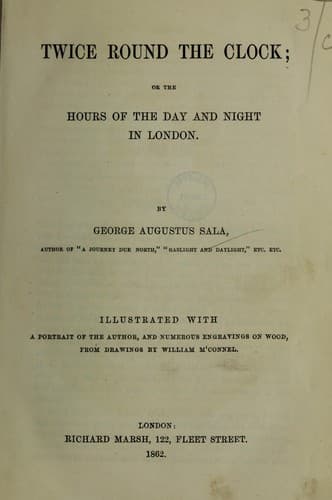
Twice round the clock; or, The hours of the day and night in LondonSala, George Augustus
General
Twice round the clock; or, The hours of the day and night in London
Sala, George Augustus
London (England) -- Social life and customs -- 19th century
A Liberal, I hope—a Democrat, if you will—on some not unimportant
public topics, I cannot help a species of meek wailing Conservatism
upon the decadence of some of our social institutions. This is the age
of abolition—of doing away with and putting down. They have robbed our
grenadiers of their worsted epaulettes. The beefeaters in the Tower have
been deprived of those scarlet and embroidered tunics, that contrasted so
quaintly with the pantaloons and highlows of everyday life, and thrust
into buttoned-up coats and brass buttons. The barristers’ wigs will go
next, I suppose, and the cocked-hat of the parish beadle—his red plush
shorts and buckled shoon are already departed. I have fears for the
opera; I tremble for the days when there will be bonnets in the upper
tiers and paletots in the pit. When I mind the opera first, it was a
subaltern’s, and not a sergeant’s, guard that kept watch and ward under
the portico. The officer on duty had a right of entrance _ex officio_
into the pit, and it was splendid to see him swinging his bearskin and
flashing his epaulettes in Fops’ Alley. The very name of Fops’ Alley is
becoming obsolete now. The next generation will forget its locality.
In those days, on drawing-room nights, the men used to come in their
court suits and uniforms, their stars and badges, the ladies in their
ostrich plumes and diamond necklaces, only taking off their trains. There
were opera-hats in those days—half moon cocked-hats; now the men carry
Gibuses like pancakes. The link boys are disappearing—the leather-lunged,
silver-badged fellows, who shouted so sonorously that Lady Sardanapalias’
carriage stopped the way. And the glories of the operatic stage; are
not those inconstant singing birds fled now? Can all the Arditis in
the world compensate for Costa, with his coat thrown back, and those
immortal, tight-fitting white kid gloves? He was the first man who ever
succeeded in parting his hair down the back; and now, he too is growing
bald, and he has cajoled Grisi the mellifluous, and Mario the heroic,
to pipe their nightingale notes among the coach-builders of Long Acre,
and the fried-fish shopmen of Drury Lane. Of the glorious unequalled,
unapproachable Four—Grisi, Rubini, Tamburini, and Lablache—who once
electrified the world in the “Puritani,” three are dead: the first is
in Covent Garden provoking malevolent criticism. Where are the other
Four, the Terpsichorean quartett, the immortals who danced the _pas de
quatre_! Ah! Mademoiselle Piccolomini, you are very arch and pretty; ah!
Mademoiselle Marie Taglioni, you are a _spirituelle_ and graceful dancer;
but you are not the giants and giantesses of the old Dead Days.
“You little people of the skies,
What are you when the sun shall rise!”
But the sun is set, and there is darkness, and I am afraid that I am
prosing _in re_ her Majesty’s Theatre, as old playgoers will prose about
Jack Bannister, sir, and Dowton, and Munden, and Fawcett.
Public-domain text, read in full here on John Shaqi.
Reviews
Reviews
No reviews yet
Be the first to share your thoughts on this work.
Elsewhere in the archive
Join the Discussion
Join the discussion
Sign in to leave a comment or review.
Sign InorCreate an account