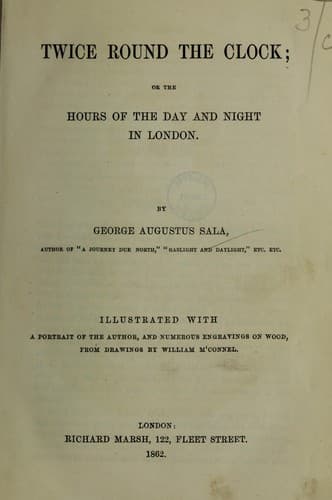
Twice round the clock; or, The hours of the day and night in LondonSala, George Augustus
General
Twice round the clock; or, The hours of the day and night in London
Sala, George Augustus
London (England) -- Social life and customs -- 19th century
There is lately come to town, at least within these latter years, an
Italian gentleman by the name of Verdi, to whose brassy screeds, and
tinkling cymbalics, it is expected that all _habitués_ of the opera
must listen, to the utter exclusion and oblivion of the old musical
worthies who delighted the world with their immortal works before Signor
Verdi was born. I have brought you to her Majesty’s Theatre, and this
is unfortunately a Verdi night. You may listen to him, but I won’t.
Thersites Theorbo, the editor of the “Spinet” (with which is incorporated
that famous musical journal the “Jew’s Harp”), may accuse me of being
“perfunctory,” or of being an ass—no one minds Thersites Theorbo,
knowing him to be a good fellow, much bemused in Cavendish tobacco and
counterpoint; but I will shut my eyes, and muse upon the bygone glories
of the opera. The place is a mass of memories. Things and books, and
scenes and men, and stories, come teeming on my brain as I sit in my
stall, heedless of Signor Verdi and his musical machinations. From
that shelf, well known to me, where nestle my dog’s-eared Rabelais, my
Montaigne, my annotated edition of Captain Grose’s Dictionary of the
Vulgar Tongue, my Shakspeare, and my beloved Jeremy Taylor, I take down
garrulous old Pepys, and read—“Jan. 12, 1667. With my Lord Brouncker
to his house, there to hear some Italian Musique, and here we met Tom
Killigrew, Sir Robert Murray, and the Italian Signor Baptista, who had
prepared a play for the Opera, which Sir T. Killigrew do intend to have
up; and here he did sing one of the acts. He is himself the poet as
well as the musician, and did sing the whole from the words without any
musique prick’d, and played all along on a harpiscon most admirably, and
the composition most excellent.” And then I mind me of an advertisement
in the “London Gazette,” in 1692, setting forth how “the Italian lady
that is lately come over, that is so famous for singing, will sing at the
concerts at York Buildings during the season.” The season! There was a
“season” in William the Deliverer’s time, then. So I call to mind Dick
Steele’s serio-comic announcement in the fourth number of the “Tattler,”
of how “Letters from the Haymarket inform us that on Saturday night last
the opera of ‘Pyrrhus and Demetrius’ was performed with great applause.”
Then from the beginning of Italian opera in England, a grand trunk line
extending to our days, I shunt off on to innumerable little branches and
loop-lines. I see the Faustina and the Cuzzoni coming to blows—Sir Robert
Walpole backing the first, his lady the second. I am, for the nonce, an
ardent partisan of Mrs. Tofts. Then I have a vision of Mrs. Fox Lane,
in a hoop of preternatural size, bidding General Crewe get out of her
house, because he professed his ignorance as to whom Signora Mingotti
was—the Mingotti who told Dr. Burney that she had “been frequently hissed
by the English for having a toothache, a cold, or a fever, to which the
Public-domain text, read in full here on John Shaqi.
Reviews
Reviews
No reviews yet
Be the first to share your thoughts on this work.
Elsewhere in the archive
Join the Discussion
Join the discussion
Sign in to leave a comment or review.
Sign InorCreate an account