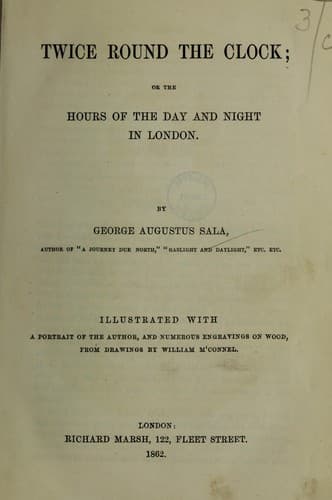
Twice round the clock; or, The hours of the day and night in LondonSala, George Augustus
General
Twice round the clock; or, The hours of the day and night in London
Sala, George Augustus
London (England) -- Social life and customs -- 19th century
Upon my word and honour there is Van Poggi, the chorus-singer, on the
stage. I am recalled at once from dreamland to actualities. There is
an old operatic saying that her Majesty’s Theatre, in the Haymarket,
could not be complete without Van Poggi, and now behold that lyrical
Widdicomb. According to the same tradition—not always trustworthy—Van
Poggi was the identical chorus-singer who assisted Velluti to alight
from his barge the night the last of those male _soprani_ made his first
appearance (in the opera of the “Crociato in Egitto”) before an audience
who had almost forgotten the fame of the Pacchierottis, the Rubinellis,
and the Marchesis. Van Poggi wears wonderfully well. Nobody knows his
exact nationality: whether he is a Dutchman, a Dane, or an Italian. His
residence has never been precisely ascertained. The management have no
occasion to rout him up, for he is always punctual at rehearsal. During
the vacation he retires to Paris, where he tells his friends that he is
to be found between ten and four every day in the Long Gallery of the
Louvre. During the London season you may contemplate Van Poggi between
the same hours in Mr. Zerubbabel’s cigar-shop in the Quadrant, at whose
door he generally stands in a Spanish cloak faced with velvet. He never
sang any better or any worse than he sings now; he was never promoted to
play the smallest separate part, such as is from time to time assigned
to the gentleman who appears in the bills as Signor N. N., or _non
nominato_. It is believed that Van Poggi would faint if he had to deliver
a line of recitative. Yet there is a very general opinion in operatic
circles that her Majesty’s Theatre would come to hopeless grief if Van
Poggi were not among the chorus. At the commencement of the season there
are always anxious inquiries at the box-office as to whether Van Poggi is
secured; and a reply being given in the affirmative, the lovers of the
lyrical drama breathe freely, and the subscription progresses. No one
knows what became of Van Poggi in the dark and dismal interregnum during
which Mr. Lumley was compelled to close his doors. Mysterious offers of
better parts, and better salaries, had, it is reported, been made to Van
Poggi, emanating from a quarter not a hundred miles from Bow Street,
Covent Garden; but the patriotic chorister scornfully refused them. He
was still seen to haunt Mr. Zerubbabel’s cigar-shop at the commencement
of the musical season; then he suddenly disappeared; and whether he went
abroad, or wrapped himself in the Spanish cloak and so lay torpid for two
years like a dormouse, must for ever remain a matter for speculation. But
it is certain that when the Haymarket Phœnix arose from its ashes, and
light once more shone on its amber satin curtains, there was Van Poggi,
at the first chorus rehearsal, as fresh as paint, and looking better
than ever. And it is moreover reported, that when his Excellency, whom a
combination of political difficulties (which began about the time some
Public-domain text, read in full here on John Shaqi.
Reviews
Reviews
No reviews yet
Be the first to share your thoughts on this work.
Elsewhere in the archive
Join the Discussion
Join the discussion
Sign in to leave a comment or review.
Sign InorCreate an account