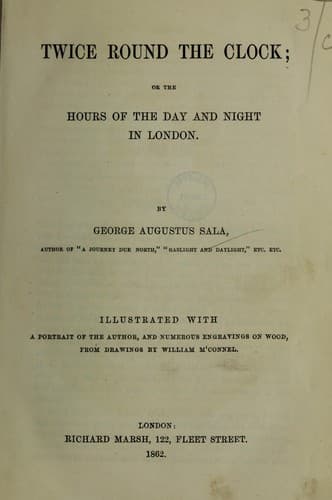
Twice round the clock; or, The hours of the day and night in LondonSala, George Augustus
General
Twice round the clock; or, The hours of the day and night in London
Sala, George Augustus
London (England) -- Social life and customs -- 19th century
good people of England will readily allow every human being to be liable
except an actress or a singer.” And then I bow down in awe before the
radiant shadow of Farinelli, great and good, unmoved by misfortune,
unspoilt by fame—Farinelli, whose dulcet notes cured a Spanish king of
madness, who was thought worthy to receive the decorations of the orders
of St. Jago and of Calatrava—Farinelli, of whom honest Will Hogarth could
not help falling a little foul in the “Rake’s Progress,” but who was,
nevertheless, as singularly modest and upright as he was unprecedentedly
gifted in his art. Unprecedentedly! recall the word. I bow before a
greater shadow, though of one who wrote, and sang not, save to his pretty
wife.[9] I see a little boy, in a grave court suit, and his young locks
curling like the tendrils of the vine, sitting before the harpsichord in
the orchestra of the great theatre of Milan. It is the first night of a
new opera, and the opera is his—this almost suckling. Upstairs, in a box
near the chandelier, is the little man’s father, sobbing, and smiling,
and vowing candles to the Virgin, if his dear child’s opera succeeds.
And it does succeed, and all Milan is full of that small maestro’s, that
maestrino’s fame, the next day. I see him again, years afterwards, grown
to be a slight, vivacious little personage, in a scarlet pelisse and a
cocked-hat. He is standing behind the scenes at the wing of the Imperial
Theatre at Vienna, and it is again the first night of the performance
of a new opera—his own. There is a singer in a Spanish costume, and who
must be, I take it, a species of barber. When he sings a song, commencing
“_Non più andrai farfallone amoroso_,” the little man in the scarlet
pelisse and cocked-hat begins to beat his palms together in applause,
and murmurs “_Bravo! Bravo!_ Benucci!” But when the singer winds up in
that magnificent exercitation to Cherubino, “_Alla vittoria! Alla gloria
militar!_” the house comes down with applause. The people shout out; the
fat-headed musicians in the orchestra beat their violin bows violently
against their desks, and (quite in defiance of operatic discipline) cry
“_Bravo! Bravo! Viva! viva! grande maestro!_” I see the same little man
lying sick and pining on his bed at Salzburg. The intrigues of Salieri,
the ingratitude of courts, the quick forgetfulness of the public, are
nothing to him now. Little does it matter if he have been indeed poisoned
with _aqua tofana_, or if he be dying of that common, but denied disease,
a broken heart. _He has written the Requiem_ (recreant Sussmayer will
strive to rob him even of _that_ fame after death), and his last hour is
approaching. The poor Swan dies; and then the sluice-gates of my eyes are
opened, and I remember that this was Johann Wolfgang von Mozart.
Public-domain text, read in full here on John Shaqi.
Reviews
Reviews
No reviews yet
Be the first to share your thoughts on this work.
Elsewhere in the archive
Join the Discussion
Join the discussion
Sign in to leave a comment or review.
Sign InorCreate an account