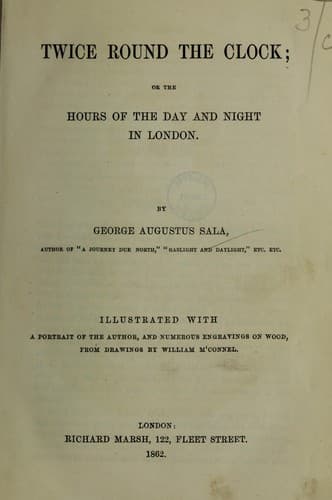
Twice round the clock; or, The hours of the day and night in LondonSala, George Augustus
General
Twice round the clock; or, The hours of the day and night in London
Sala, George Augustus
London (England) -- Social life and customs -- 19th century
Where the long lane from St. Giles’s to the Strand divides the
many-branching slums; where flares the gas over coarse scraps of meat in
cheap butchers’ shops; where brokers pile up motley heaps of second-hand
wares—from fishing-rods and bird-cages to flat-irons and blankets;
from cornet-à-pistons and “Family Encyclopædias” to corkscrews and
fowling-pieces; where linen-drapers are invaded by poorly-clad women
and girls, demanding penn’orths of needles, ha’porths of buttons, and
farthingworths of thread; where jean stays flap against the door jambs,
and “men’s stout hose” gleam gaunt in the shop-windows; where grimy dames
sit in coal and potato-sheds, and Jew clothesmen wrestle for the custom
of passengers who don’t want to buy anything; where little dens, reeking
with the odours of fried fish, sausages, and baked potatoes, or steaming
with reminders of à-la-mode beef and hot eel soup, offer suppers, cheap
and nasty, to the poor in pocket; where, in low coffee-shops, newspapers
a fortnight old, with coffee-cup rings on them, suggest an intellectual
pabulum, combined with bodily refreshment; where gaping public-houses
receive or disgorge their crowds of tattered topers; where “general
shops” are packed to overflowing with heterogeneous odds and ends—soap,
candles, Bath brick, tobacco, Dutch cheese, red herrings, firewood,
black lead, streaky bacon, brown sugar, birch brooms, lucifer matches,
tops, marbles, hoops, brandy balls, packets of cocoa, steel pens,
cheap periodicals, Everton toffy, and penny canes; where on each side,
peeping down each narrow thoroughfare, you see a repetition only of
these scenes of poverty and misery; where you have to elbow and jostle
your way through a teeming, ragged, ill-favoured, shrieking, fighting
population—by oyster-stalls and costermongers’ barrows—by orange-women
and organ-grinders—by flower-girls and match-sellers—by hulking labourers
and brandy-faced viragos, squabbling at tavern doors—by innumerable
children in every phase of weazened, hungry, semi-nakedness, who
pullulate at every corner, and seem cast up on the pavement like pebbles
on the sea-shore. Here, at last, we find the hostelry of the three
golden balls, where the capitalist, whom men familiarly term “my uncle,”
lends money on the security of plate, jewellery, linen, wearing apparel,
furniture, bedding, books—upon everything, in fact, that is not in itself
of so perishable a nature as to warrant the probability of its rotting
upon my uncle’s shelves.
Public-domain text, read in full here on John Shaqi.
Reviews
Reviews
No reviews yet
Be the first to share your thoughts on this work.
Elsewhere in the archive
Join the Discussion
Join the discussion
Sign in to leave a comment or review.
Sign InorCreate an account