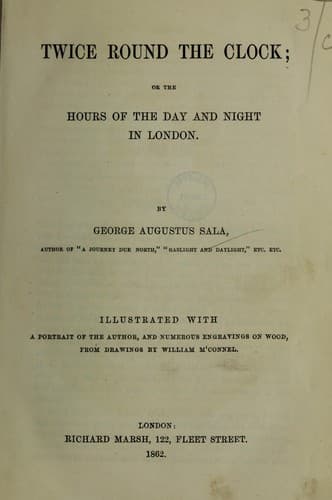
Twice round the clock; or, The hours of the day and night in LondonSala, George Augustus
General
Twice round the clock; or, The hours of the day and night in London
Sala, George Augustus
London (England) -- Social life and customs -- 19th century
The pawnbroker’s shop window—the _étalage_, as our Parisian neighbours
would term it—presents a medley of merchandise for sale; for I suppose
the host of the three balls buys-in sundry articles at the quarterly
sales of unredeemed pledges, of whose aspect you have already had an
inkling in these pages, which he thinks are likely to sell in his
particular neighbourhood. Of course, the nature and quality of the
articles exhibited vary according to the locality. In fashionable
districts (for even Fashion cannot dispense with its pawnbrokers) you
may see enamels and miniatures, copies of the Italian masters, porcelain
vases, bronze statuettes, buhl clocks, diamond rings, bracelets, watches,
cashmere shawls, elegantly-bound books, and cases of mathematical
instruments; but we are now in an emphatically low neighbourhood,
and such articles as I have alluded to are likely to attract but few
purchasers. Rather would there seem a chance of a ready sale for the
bundles of shirts, and women’s gear, and cheap printed shawls; for the
saws, and planes, adzes, gimlets, and chisels; for the cotton umbrellas;
for the heavy silver watches that working men wear (though they, even,
are not plentiful); for the infinity of small cheap wares, for sale at an
alarming reduction of prices.
Let us enter. Behold the Bezesteen of borrowed money. This, too, might be
compared, with a grim mockery, to the theatre; for hath it not private
boxes and a capacious stage, on which is continually being performed the
drama of the “Rent Day,” and the tragi-comedy of “Lend me Five Shillings?”
See the pawners, so numerous that the boxes can no longer remain private,
and two or three parties, total strangers to one another, are all crowded
into the same aperture. It is Saturday night, and they are deliriously
anxious to redeem their poor little remnants of wearing apparel for
that blessed Sunday that comes to-morrow, to be followed, however, by
a Black Monday, when father’s coat, and Polly’s merino frock, nay the
extra petticoat, nay the Lilliputian boots of the toddling child, will
have to be pawned again. Certain wise men, political economists and
pseudo-philanthropists, point at the plethora of pawnbrokers’ shops as
melancholy proofs of the poor’s improvidence. But the poor are _so_ poor,
they have at the best of times so very little money, that pawning with
them is an absolute necessity; and the pawnbroker’s shop, that equitable
mortgage on a small scale, is to them rather a blessing than a curse.
Without that fourpence on the flat-iron, there would be very frequently
no bread in the cupboard.
Public-domain text, read in full here on John Shaqi.
Reviews
Reviews
No reviews yet
Be the first to share your thoughts on this work.
Elsewhere in the archive
Join the Discussion
Join the discussion
Sign in to leave a comment or review.
Sign InorCreate an account