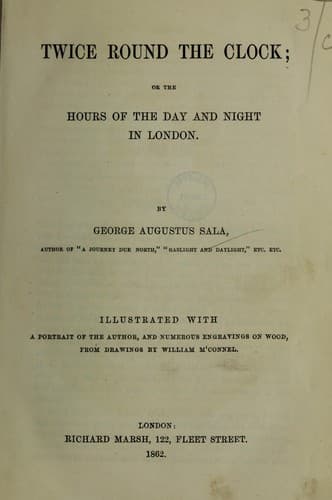
Twice round the clock; or, The hours of the day and night in LondonSala, George Augustus
General
Twice round the clock; or, The hours of the day and night in London
Sala, George Augustus
London (England) -- Social life and customs -- 19th century
Although I am a devotee of the opera, and am always glad when Drury
Lane doors are open, and mourn over the decadence of the Lyceum, and
wish that the Strand would succeed,[10] and longed for the day when
the resuscitated Adelphi should open its doors, and rejoice at the
prosperity of the Olympic, and think that one of the most rational and
delightful night’s amusements in Europe, may be attained by the sight
of the “Merchant of Venice” at the now closed (so far as Charles Kean
is concerned) Princess’s, I have yet a tenderness, a predilection, an
almost preference, for the Vic. There is a sturdy honesty of purpose,
unity of action, sledge-hammer morality about the rubbishing melodramas,
which are nightly yelled and ranted through on the Victoria stage, that
are productive, I believe, of an intellectual tone, highly healthful and
beneficial. Burkins, the garotter, who is now in hold in Pentonville for
his sins, and is so promising a pupil of the chaplain, (having nearly
learnt the Gunpowder Plot service and the prohibitions of consanguinity
by heart,) has confidentially informed his reverend instructor that to
the melodramas at the Victoria must be ascribed his ruin. It was the
“Lonely Man of the Ocean” that led him to fall on Mr. Jabez Cheddar,
cheesemonger, in Westminster Broadway, at two o’clock in the morning,
split his skull open with a life-preserver, jump upon him, and rob him of
eight pounds twelve, a silver hunting-watch, and a brass tobacco-box; at
which confession the chaplain orders him more beef and books, and puts
him down in the front rank for his next recommendatory report to the
visiting magistrates. Partaking, in company with some other persons, of
the opinion that Burkins adds to the characteristics of a ruffian and
a blockhead, those of a hypocrite and a Liar, I do not necessarily set
much store by the expression of _his_ opinions on the British drama. But
when I find shrewd police-inspectors and astute stipendiary magistrates
moralising over the dreadful effects of cheap theatres, attended as
they are by the “youth of both sexes,” I deem them foemen worthy of my
steel. Good Mr. Inspector, worthy Master Justice, where are the youth
and the adults of both sexes to go in quest of that amusement, which I
suppose you will concede to them, of some nature, the necessity? Are
the churches open on week nights, and to such as they? and would you
yourselves like to sit under Doctor Cumming, or even Mr. Spurgeon, from
Saturday to Saturday? Are they to go to the Opera, to Almack’s, to the
Carlton Club, or to the conversaziones of the Geological Society? You
object, you say, to the nature of the entertainments provided for them.
Come with me, and sit on the coarse deal benches in the coarsely and
tawdrily-decorated cheap theatre, and listen to the sorrily-dressed
actors and actresses—periwigged-pated fellows and slatternly wenches,
if you like—tearing their passion to tatters, mouthing and ranting,
Public-domain text, read in full here on John Shaqi.
Reviews
Reviews
No reviews yet
Be the first to share your thoughts on this work.
Elsewhere in the archive
Join the Discussion
Join the discussion
Sign in to leave a comment or review.
Sign InorCreate an account