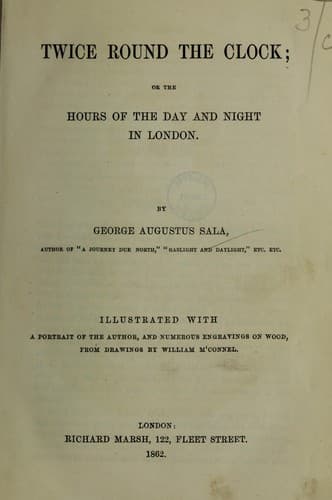
Twice round the clock; or, The hours of the day and night in LondonSala, George Augustus
General
Twice round the clock; or, The hours of the day and night in London
Sala, George Augustus
London (England) -- Social life and customs -- 19th century
and splitting the ears of the groundlings. But in what description of
pieces? In dramas, I declare and maintain, in which, for all the jargon,
silliness, and buffoonery, the immutable principles of right and justice
are asserted; in which virtue, in the end, is always triumphant, and
vice is punished; in which cowardice and falsehood are hissed, and
bravery and integrity vehemently applauded; in which, were we to sift
away the bad grammar, and the extravagant action, we should find the
dictates of the purest and highest morality. These poor people can’t help
misplacing their h’s, and fighting combats of six with tin broadswords.
They haven’t been to the university of Cambridge; they can’t compete for
the middle-class examinations; they don’t subscribe to the “Saturday
Review;” they have never taken dancing lessons from Madame Michau; they
have never read Lord Chesterfield’s Letters; they can’t even afford to
purchase a “Shilling Handbook of Etiquette.” Which is best? That they
should gamble in low coffee-shops, break each other’s heads with pewter
pots in public-houses, fight and wrangle at street corners, or lie in
wait in doorways and blind alleys to rob and murder, or that they should
pay their threepence for admission into the gallery of the “Vic.”—witness
the triumph of a single British sailor over twelve armed ruffians, who
are about to carry off the Lady Maud to outrage worse than death; see
the discomfiture of the dissolute young nobleman, and the restitution
of the family estates (through the timely intervention of a ghost in a
table-cloth) to the oppressed orphan? And of this nature are the vast
mass of transpontine melodramas. The very “blood-and-murder” pieces, as
they are termed, always end with the detection of the assassin and his
condign punishment. George Cruikshank’s admirable moral story of “The
Bottle” was dramatised at the “Vic.,” and had an immense run. They are
performing “Never Too Late to Mend,” now, over the water, to crowded
houses. If we want genteel improprieties, sparkling immoral repartees,
decorously scandalous intrigues, and artful cobwebs of _double entendre_,
touching on the seventh commandment, we must cross the bridges and
visit the high-priced, fashionably-attended theatres of the West-end.
At a West-end theatre, was produced the only immoral version of an
immoral (and imbecile) “Jack Sheppard,” which is, even now, vauntingly
announced as being the “authorised version”—the only one licensed by
the Lord Chamberlain; and in that “authorised version” occurs the line,
“Jack Sheppard is a thief, but he never told a lie,” a declaration than
which the worst dictum of howling Tom Paine or rabid Mary Wolstoncraft
was not more subversive of the balance of moral ethics. And, at a
West-end theatre, likewise, his Lordship the Chamberlain authorised the
production of a play, whose story, regarded either as a melodrama or
as the libretto of a trashy Italian opera, has not been equalled for
Public-domain text, read in full here on John Shaqi.
Reviews
Reviews
No reviews yet
Be the first to share your thoughts on this work.
Elsewhere in the archive
Join the Discussion
Join the discussion
Sign in to leave a comment or review.
Sign InorCreate an account